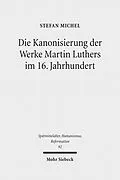
In this volume, Stefan Michel investigates for the first time how the canonisation of Luther's Bible, collected works and Augsburg Confession was undertaken in the 16th century.
Following Martin Luther's death, his reformatory work had to be preserved and passed on to the next generation. Within the group of Wittenberg theologians there were various interpretations however, for example, those represented by Nikolaus von Amsdorf or Philipp Melanchthon. In this volume, Stefan Michel investigates for the first time how the canonisation of Luther's Bible, collected works and Augsburg Confession was undertaken in the 16th century. Going on the basis of archival sources in particular, the author traces the origin and effect of 1581's "Standard Bible", the competing Wittenberg and Jena Lutheran editions as well as the consolidation of the confessions in the Book of Concord. Changing carriers of the canonisation process, territorial priorities and theological issues that have determined Luther's image right up to the present come into view.
Autorentext
Geboren 1975; Studium der Ev. Theologie in Jena, Tübingen und Leipzig; 2006 Promotion; 2008 Ordination; 2015 Habilitation; Arbeitsstellenleiter des Akademievorhabens "Briefe und Akten zur Kirchenpolitik Friedrichs des Weisen und Johanns des Beständigen 1513 bis 1532. Reformation im Kontext frühneuzeitlicher Staatswerdung" an der Sächsischen Akademie der Wissenschaften zu Leipzig.
Following Martin Luther's death, his reformatory work had to be preserved and passed on to the next generation. Within the group of Wittenberg theologians there were various interpretations however, for example, those represented by Nikolaus von Amsdorf or Philipp Melanchthon. In this volume, Stefan Michel investigates for the first time how the canonisation of Luther's Bible, collected works and Augsburg Confession was undertaken in the 16th century. Going on the basis of archival sources in particular, the author traces the origin and effect of 1581's "Standard Bible", the competing Wittenberg and Jena Lutheran editions as well as the consolidation of the confessions in the Book of Concord. Changing carriers of the canonisation process, territorial priorities and theological issues that have determined Luther's image right up to the present come into view.
Autorentext
Geboren 1975; Studium der Ev. Theologie in Jena, Tübingen und Leipzig; 2006 Promotion; 2008 Ordination; 2015 Habilitation; Arbeitsstellenleiter des Akademievorhabens "Briefe und Akten zur Kirchenpolitik Friedrichs des Weisen und Johanns des Beständigen 1513 bis 1532. Reformation im Kontext frühneuzeitlicher Staatswerdung" an der Sächsischen Akademie der Wissenschaften zu Leipzig.
Titel
Die Kanonisierung der Werke Martin Luthers im 16. Jahrhundert
Autor
EAN
9783161586309
Format
E-Book (pdf)
Hersteller
Genre
Digitaler Kopierschutz
Adobe-DRM
Dateigrösse
16.78 MB
Anzahl Seiten
400
Lesemotiv
Unerwartete Verzögerung
Ups, ein Fehler ist aufgetreten. Bitte versuchen Sie es später noch einmal.