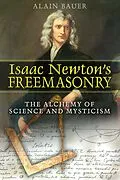
An exploration of how modern Freemasonry enabled Isaac Newton and his like-minded contemporaries to flourish
• Shows that Freemasonry, as a mystical order, was conceived as something new--an amalgam of alchemy and science that had little to do with operative Freemasonry
• Reveals how Newton and his friends crafted this "speculative," symbolic Freemasonry as a model for the future of England
• Connects Rosslyn Chapel, Henry Sinclair, and the Invisible College to Newton and his role in 17th-century Freemasonry
Freemasonry, as a fraternal order of scientists and philosophers, emerged in the 17th century and represented something new--an amalgam of alchemy and science that allowed the creative genius of Isaac Newton and his contemporaries to flourish. In Isaac Newton's Freemasonry, Alain Bauer presents the swirl of historical, sociological, and religious influences that sparked the spiritual ferment and transformation of that time. His research shows that Freemasonry represented a crossroads between science and spirituality and became the vehicle for promoting spiritual and intellectual egalitarianism. Isaac Newton was seminal in the "invention" of this new form of Freemasonry, which allowed Newton and other like-minded associates to free themselves of the church's monopoly on the intellectual milieu of the time.
This form of Freemasonry created an ideological blueprint that sought to move England beyond the civil wars generated by its religious conflicts to a society with scientific progress as its foundation and standard. The "science" of these men was rooted in the Hermetic tradition and included alchemy and even elements of magic. Yet, in contrast to the endless reinterpretations of church doctrine that fueled the conflicts ravaging England, this new society of Accepted Freemasons provided an intellectual haven and creative crucible for scientific and political progress. This book reveals the connections of Rosslyn Chapel, Henry Sinclair, and the Invisible College to Newton's role in 17th-century Freemasonry and opens unexplored trails into the history of Freemasonry in Europe.
Autorentext
Alain Bauer, a researcher and historian, is the current Grand Master of the Grand Orient of France. He is the author in French of Grand O and Le Grand Orient de France.
Inhalt
FOREWORD by Michel Barat, Grand Master of the Grand Lodge of France
INTRODUCTION
1 A RETURN TO THE ORIGINS
2 ROBERT MORAY AND THE ROYAL SOCIETY
The Founders
The First Presidents of the Royal Society
3 NEWTON: SCIENTIST, ALCHEMIST, AND SORCERER
4 THE BIRTH OF FREEMASONRY
AFTERWORD by Roger Dachez, President of the Masonic Institute of France
APPENDIX 1: Summary of the History of Freemasonry
APPENDIX 2: The Grand Masters of England