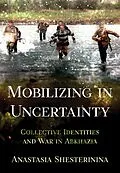
Winner of the Davis Center Book Prize in Political and Social Studies
Co-winner of the Charles Taylor Book Award
How do ordinary people navigate the intense uncertainty of the onset of war? Individuals mobilize in different ways-some flee, some pick up arms, and some support armed actors. Drawing on nearly two hundred in-depth interviews with participants and nonparticipants in the Georgian-Abkhaz war of 1992-1993, Mobilizing in Uncertainty explores Abkhaz mobilization decisions during that conflict.
Anastasia Shesterinina uncovers that to make sense of the violence, Abkhaz leaders, local authority figures, and others relied on shared understandings of the conflict and their roles in it-collective conflict identities-that they had developed before the war. People consolidated mobilization decisions within small groups of family and friends and based their actions on whom they understood to be threatened and mobilized to protect. Their decisions shaped how the Georgian-Abkhaz conflict unfolded. Mobilizing in Uncertainty sheds light on broader processes of violence, which have lasting effects on societies marked by intergroup conflict.
Autorentext
Anastasia Shesterinina
Klappentext
How do ordinary people navigate the intense uncertainty of the onset of war? Different individuals mobilize in different ways-some flee, some pick up arms, and some support armed actors as civil war begins. Drawing on nearly two hundred in-depth interviews with participants and nonparticipants in the Georgian-Abkhaz war of 1992-1993, Anastasia Shesterinina explores Abkhaz mobilization decisions during that conflict.
Her fresh approach underscores the uncertain nature of the first days of the war when Georgian forces had a preponderance of manpower and arms. Mobilizing in Uncertainty demonstrates, in contrast to explanations that assume individuals know the risk involved in mobilization and make decisions based on that knowledge, that the Abkhaz anticipated risk in ways that were affected by their earlier experiences and by social networks at the time of mobilization.
What Shesterinina uncovers is that to make sense of the violence, Abkhaz leaders, local authority figures, and others relied on shared understandings of the conflict and their roles in it-collective conflict identities-that they had developed before the war. As appeals traveled across society, people consolidated mobilization decisions within small groups of family and friends and based their actions on whom they understood to be threatened. Their decisions shaped how the Georgian-Abkhaz conflict unfolded and how people continued to mobilize during and after the war.
Through this detailed analysis of Abkhaz mobilization from prewar to postwar, Mobilizing in Uncertainty sheds light on broader processes of violence, which have lasting effects on societies marked by intergroup conflict.
Inhalt
Introduction: The Puzzle of Mobilization
1. Studying Civil War Mobilization
2. A Sociohistorical Approach to Mobilization
3. Collective Historical Memory
4. Prewar Conflict Identities
5. From Uncertainty to Mobilization in Four Days
6. From Mobilization to Fighting
7. Postwar Abkhazia
Conclusion: Uncertainty and Mobilization in Civil War