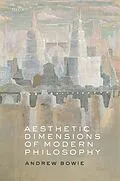
The agenda of analytical philosophy is heavily influenced by the assumptions governing modern scientific knowledge. Such philosophy can consequently neglect questions about why and how things matter at all. Aesthetic Dimensions of Modern Philosophy explores the idea that, because they offer responses to existential questions of meaning, art and aesthetics are vital for the future of philosophy. Andrew Bowie regards the development of modern scepticism, not primarily as an epistemological problem to be solved, but rather as a symptom of how traditional ways of making sense of the world are disrupted in modernity. The modern attention to art and aesthetics is a response to this disruption, and is explored in Montaigne, Descartes, Hume, Kant, Schelling, the early German Romantics, Hegel, and Cassirer. The work of Karl Polanyi, Marx, Nietzsche, Heidegger, Adorno, Dewey, and others can suggest how the modern sciences and capitalism change humankind's relationship to nature, and so transform the significance of art, such that art can become a kind of philosophy, and philosophy a kind of art.
Autorentext
Andrew Bowie is Professor Emeritus of Philosophy and German at Royal Holloway, University of London. He has published very widely on Philosophy, as well as musical and literary topics, including German Philosophy: A Very Short Introduction. He studied Modern Languages at Cambridge University and attained a PhD in Comparative Literature at the University of East Anglia. He was a DAAD scholar at the Free University in Berlin, Professor of Philosophy at Anglia Ruskin University, Alexander von Humboldt Research Fellow in Philosophy at Tübingen University, and twice Leverhulme Major Research Fellow in Philosophy. He is also a jazz saxophonist.
Klappentext
Much of contemporary philosophy, especially in the analytical tradition, regards aesthetics as of lesser significance than epistemology, ethics, metaphysics, and the philosophy of language. Yet, in Aesthetic Dimensions of Modern Philosophy, Andrew Bowie explores the idea that art and aesthetics have crucial implications for those areas of philosophy. In the modern period, the growth of warranted scientific knowledge is accompanied both by heightened concern with epistemological scepticism and a new philosophical attention to art and the beauty of nature. This suggests that modernity involves problems concerning how human beings make sense of the world that go beyond questions of knowledge, and are reflected in the arts. The relationship of art to philosophy is explored in Montaigne, Descartes, Hume, Kant, Schelling, the early German Romantics, and Hegel. This book also considers Cassirer's and the hermeneutic tradition's exploration of close links between meaning in language and in art. The work of Karl Polanyi, Marx, Nietzsche, Heidegger, Adorno, Dewey, and others is used to investigate how the modern sciences and the development of capitalism change both humankind's relations to nature and the nature of value, and so affect the role of art in human self-understanding. The aesthetic dimensions of modern philosophy can help to uncover often neglected historical shifts in how 'subjective' and 'objective' are conceived. Seeing art as a kind of philosophy, and philosophy as a kind of art, reveals unresolved tensions between the different cultural domains of the modern world and questions some of the orientation of contemporary philosophy.