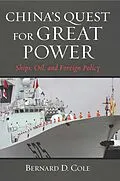
This book addresses three important facets of China's modern development. First is the ongoing modernization of the People's Liberation Army Navy (PLAN). The Chinese navy has grown from a relatively small, backward force in the 1980s into a capable twenty-first century maritime power. The PLAN now deploys around the world and includes nuclear-powered submarines, the first of several aircraft carriers, modern guided missile destroyers and frigates, and the world's most formidable force of seagoing cruise and ballistic missiles. This modern, growing navy is intended in significant part to undergird China's global search for energy sources and security. Beijing's determination to maintain its historic economic growth depends on energy security. These two national priorities-a navy capable of defending China's national security and economic interests and secury energy resources-come together to define and support Chinese foreign policy. This book addresses these three in both global and Asian contextual terms, with special emphasis on relations between China and the United States.
Autorentext
Bernard D. Cole, Captain, USN (Ret.), is Professor Emeritus at the National War College He commanded USS RATHBURNE (FF1057) and Destroyer Squadron 35, and also served as a Naval Gunfire Liaison Officer with the THIRD Marine Division in Vietnam from June 1967 to July 1968. Cole was named the U.S. Naval Institute Press "Author of the Year" for 2015. He earned a Ph.D. in History from Auburn University. This is his eighth book on Asian energy security and maritime affairs.
Klappentext
This book examines China's national security strategy by looking at the three major elements-foreign policy, energy security, and naval power-all interactive and major influences on China's future and its relations with the United States. A decade and a half into the twenty-first century, Beijing requires reliable access to energy resources, the navy to defend that access, and foreign policies to navigate safely toward its goals. Most importantly, the People's Liberation Army-Navy (PLAN) must be able to safeguard China's regional maritime interests, especially the sovereignty disputes involving Taiwan and the Yellow, East China, and South China Seas. Many Chinese naval officers and analysts think the United States is determined to contain China and prevent it from achieving the dominant historical position to which it is entitled. This view has been strengthened by Washington's shift to Asia, transfer of naval units to the Pacific, and the March 2015 Maritime Strategy released by the U.S. Navy, Marine Corps, and Coast Guard. China's relationship with the United States is vital to both countries and to the world. The relationship is based on both common and divergent interests in economics, military operations, and political goals and methods. China's international trading economy and ambition for a world-class navy require effective foreign diplomacy and participation in global affairs. This policy trifecta in large part defines China's posture to the world. Beijing is approximately halfway toward its mid-century goal of deploying a navy capable of defending China's perceived maritime interests. China's priorities follow President Xi Jinping's definition of national security as "comprehensive, encompassing politics, the military, the economy, technology, the environment and culture." What this means for future Chinese foreign policy choices, as naval modernization and energy security concerns enable different courses of action, lies at the center of this book's conclusions.
Titel
China's Quest for Great Power
Untertitel
Ships, Oil, and Foreign Policy
Autor
EAN
9781682471456
Format
E-Book (epub)
Hersteller
Veröffentlichung
15.09.2016
Digitaler Kopierschutz
Wasserzeichen
Anzahl Seiten
320
Unerwartete Verzögerung
Ups, ein Fehler ist aufgetreten. Bitte versuchen Sie es später noch einmal.