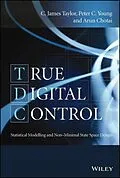
True Digital Control: Statistical Modelling and Non-Minimal State Space Designdevelops a true digital control design philosophy that encompasses data-based model identification, through to control algorithm design, robustness evaluation and implementation. With a heritage from both classical and modern control system synthesis, this book is supported by detailed practical examples based on the authors' research into environmental, mechatronic and robotic systems. Treatment of both statistical modelling and control design under one cover is unusual and highlights the important connections between these disciplines.
Starting from the ubiquitous proportional-integral controller, and with essential concepts such as pole assignment introduced using straightforward algebra and block diagrams, this book addresses the needs of those students, researchers and engineers, who would like to advance their knowledge of control theory and practice into the state space domain; and academics who are interested to learn more about non-minimal state variable feedback control systems. Such non-minimal state feedback is utilised as a unifying framework for generalised digital control system design. This approach provides a gentle learning curve, from which potentially difficult topics, such as optimal, stochastic and multivariable control, can be introduced and assimilated in an interesting and straightforward manner.
Key features:
- Covers both system identification and control system design in a unified manner
- Includes practical design case studies and simulation examples
- Considers recent research into time-variable and state-dependent parameter modelling and control, essential elements of adaptive and nonlinear control system design, and the delta-operator (the discrete-time equivalent of the differential operator) systems
- Accompanied by a website hosting MATLAB examples
True Digital Control: Statistical Modelling and Non-Minimal State Space Design is a comprehensive and practical guide for students and professionals who wish to further their knowledge in the areas of modern control and system identification.
Autorentext
James Taylor received his B.Sc. (Hons.) and Ph.D degrees from Lancaster University, UK, before joining the academic staff of the Engineering Department in 2000. His research focuses on control system design and system identification, with applied work spanning robotics, transport, energy, agriculture and the environment. This has led to over 100 publications in the open literature and widespread impact across a variety of academic and industrybased users. He has pioneered new advances in nonminimal state space design, and coordinates development of the wellknown Captain Toolbox for Time Series Analysis and Forecasting. He is a Fellow of the Institution of Engineering and Technology, and supervises students across a spectrum of mechanical, electronic, nuclear and chemical engineering disciplines.
Peter Young is Emeritus Professor at Lancaster University, UK, and Adjunct Professor at the Australian National University, Canberra. After an apprenticeship in the Aerospace Industry and B.Tech., MSc. degrees from Loughborough University, he obtained his Ph.D degree from Cambridge University in 1970 and became University Lecturer in Engineering and a Fellow of Clare Hall at Cambridge University. After seven years as Professorial Fellow at the Australian National University, he then moved to Lancaster University in 1981 as Professor and Head of the Environmental Science Department. He is well known for his work on optimal identification, databased mechanistic modelling and adaptive forecasting, with applications in areas ranging from the environment, through ecology, biology and engineering to business and macroeconomics.
Until his recent retirement, Arun Chotai was Senior Lecturer in the Lancaster Environment Centre at Lancaster University, UK. He holds a Ph.D in Systems and Control and a B.Sc. (Hons.) in Mathematics, both from the University of Bath, UK. Following his appointment to an academic position at Lancaster in 1984, he taught and developed modules in environmental systems, courses that were then unique to the UK in providing an advanced, quantitative approach to the subject. For many years, he was also joint head (with present coauthor Peter Young) of the Systems and Control Group, which he helped to build into a successful research unit that became known internationally for its research in the areas of system identification, timeseries analysis and control system design.
Klappentext
True Digital Control: Statistical Modelling and NonMinimal State Space Design develops a true digital control design philosophy that encompasses databased model identification, through to control algorithm design, robustness evaluation and implementation. With a heritage from both classical and modern control system synthesis, this book is supported by detailed practical examples based on the authors' research into environmental, mechatronic and robotic systems. Treatment of both statistical modelling and control design under one cover is unusual and highlights the important connections between these disciplines.
Starting from the ubiquitous proportionalintegral controller, and with essential concepts such as pole assignment introduced using straightforward algebra and block diagrams, this book addresses the needs of those students, researchers and engineers, who would like to advance their knowledge of control theory and practice into the state space domain; and academics who are interested to learn more about
nonminimal state variable feedback control systems. Such nonminimal state feedback is utilised as a unifying framework for generalised digital control system design. This approach provides a gentle learning
curve, from which potentially difficult topics, such as optimal, stochastic and multivariable control, can be introduced and assimilated in an interesting and straightforward manner.
Key features:
•Covers both system identification and control system design in a unified manner
•Includes practical design case studies and simulation examples
•Considers recent research into timevariable and statedependent parameter modelling and control, essential elements of adaptive and nonlinear control system design, and the deltaoperator (the discretetime equivalent of the differential operator) systems
•Accompanied by a website hosting MATLAB® examples
True Digital Control: Statistical Modelling and NonMinimal State Space Design is a comprehensive and practical guide for students and professionals who wish to further their knowledge in the areas of modern control and system identification.
Inhalt
Preface xiii
List of Acronyms xv
List of Examples, Theorems and Estimation Algorithms xix
1 Introduction 1
1.1 Control Engineering and Control Theory 2
1.2 Classical and Modern Control 5
1.3 The Evolution of the NMSS Model Form 8
1.4 True Digital Control 11
1.5 Book Outline 12
1.6 Concluding Remarks 13
References 14
2 Discrete-Time Transfer Functions 17
2.1 Discrete-Time TF Models 18
2.1.1 The Backward Shift Operator 18
2.1.2 General Discrete-Time TF Model 22
2.1.3 Steady-State Gain 23
2.2 Stability and the Unit Circle 24
2.3 Block Diagram Analysis 26
2.4 Discrete-Time Control 28
2.5 Continuous to Discrete-Time TF Model Conversion 36
2.6 Concluding Remarks 38
References 38
3 Minimal State Variable Feedback 41
3.1 Controllable Canonical Form 44
3.1.1 State Variable Feedback for the General TF Model 49
3.2 Observabl…