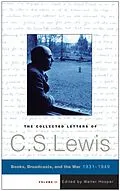
The second of a three-volume collection of the letters of C.S. Lewis, this volume contains many letters to prominent thinkers and writers, including Dom Bede Griffiths and Dorothy L. Sayers. The theology and ideas revealed in these pages provide insight into Lewis's thoughts after his conversion to Christianity, as he began a lifetime of serious writing.
C.S. Lewis was a prolific letter writer and his personal correspondence reveals much of his private life, reflections, friendships and feelings. The letters found in Volume II reveal inside accounts of how The Screwtape Letters came to be written, the early meetings of the Inklings (with J.R.R. Tolkien giving readings about "hobbits" and "Middle Earth"), how C.S. Lewis came to be known through his BBC Radio talks during World War II, but mostly how this quiet bachelor professor in England touched the lives of many through an amazing discipline of personal correspondence. Clive Staples Lewis (1898-1963) was born in Belfast. He was a fellow and tutor in English Literature at Magdalen College, Oxford, and was later Professor of Medieval and Renaissance Literature at Cambridge University, where he remained until his death. His major contributions in literary criticism, children's literature, fantasy literature, and popular theology brought him international renown and acclaim. Lewis's most distinguished and popular accomplishments include The Chronicles of Narnia, Out of the Silent Planet, The Four Loves, The Screwtape Letters, and Mere Christianity.Autorentext
Clive Staples Lewis (1898-1963) was one of the intellectual giants of the twentieth century and arguably one of the most influential writers of his day. He was a Fellow and Tutor in English Literature at Oxford University until 1954, when he was unanimously elected to the Chair of Medieval and Renaissance Literature at Cambridge University, a position he held until his retirement. He wrote more than thirty books, allowing him to reach a vast audience, and his works continue to attract thousands of new readers every year. His most distinguished and popular accomplishments include Out of the Silent Planet, The Great Divorce, The Screwtape Letters, and the universally acknowledged classics The Chronicles of Narnia. To date, the Narnia books have sold over 100 million copies and have been transformed into three major motion pictures.
Clive Staples Lewis (1898-1963) fue uno de los intelectuales ms importantes del siglo veinte y podra decirse que fue el escritor cristiano ms influyente de su tiempo. Fue profesor particular de literatura inglesa y miembro de la junta de gobierno en la Universidad Oxford hasta 1954, cuando fue nombrado profesor de literatura medieval y renacentista en la Universidad Cambridge, cargo que desempe hasta que se jubil. Sus contribuciones a la crtica literaria, literatura infantil, literatura fantstica y teologa popular le trajeron fama y aclamacin a nivel internacional. C. S. Lewis escribi ms de treinta libros, lo cual le permiti alcanzar una enorme audiencia, y sus obras an atraen a miles de nuevos lectores cada ao. Sus ms distinguidas y populares obras incluyen Las Crnicas de Narnia, Los Cuatro Amores, Cartas del Diablo a Su Sobrino y Mero Cristianismo.