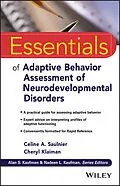
A practical guide to adaptive behaviors across a range of neurodevelopmental disorders
Adaptive behavior assessment measures independent living skills, including communication, social skills, personal care, and practical work skills. For individuals with intellectual disabilities, evaluation of these skills is a critical tool for measuring eligibility and can identify specific skills that must be learned before effective educational interventions can be implemented. Essentials of Adaptive Behavior Assessment of Neurodevelopmental Disorders describes the role of adaptive behavior in assessment and treatment, and provides clear guidance for measurement. Case samples provide real-world illustration of behaviors and assessment, and systematic comparison of various measures are presented and explained to better inform planning.
Individual chapters outline specific adaptive behaviors across a range of neurodevelopmental disorders, giving clinicians, practitioners, students, and researchers a better understanding of diagnostic differentials and how to place independent skill programming in treatment and intervention.
* Plan intervention and treatment based on accessible measurement guidelines across a range of disorders
* Gain a deeper understanding of adaptive functioning specific to ADHD, autism spectrum disorders, disruptive behavior disorders, and genetic disorders
* Compare and contrast current measures to evaluate their strengths, weaknesses, and areas of overlap
* Quickly locate essential information with Rapid Reference and Caution boxes
For individuals with neurodevelopmental disorders, adaptive behaviors are the keys to independence; without them, these individuals will perpetually struggle with achieving optimum independence without the basic skills needed to function at home, in school, and in the community. Assessment allows these skills to be factored in to treatment and intervention planning, and can help improve the outcomes of other intervention methods. Essentials of Adaptive Behavior Assessment of Neurodevelopmental Disorders clarifies the assessment of these important behaviors, helping clinicians make more informed decisions around diagnosis, education, and treatment planning.
Autorentext
CELINE A. SAULNIER, PHD, and CHERYL KLAIMAN, PHD, are Associate Professors in the Department of Pediatrics at the Emory University School of Medicine & Marcus Autism Center, Children's Healthcare of Atlanta.
Klappentext
- A practical guide for assessing adaptive behavior
- Expert advice on interpreting profiles of adaptive functioning
- Conveniently formatted for Rapid Reference
A comprehensive guide to adaptive behaviors across a range of neurodevelopmental disorders
Essentials of Adaptive Behavior Assessment of Neurodevelopmental Disorders offers a practical and concise guide that explores the role of adaptive behavior in assessment and treatment and contains clear guidelines for measurement. The text includes case samples that provide real-world illustrations of behaviors and assessment. Also included are systematic comparisons of various measures that are designed to help better inform planning. Written to promote a deeper understanding of the use of assessment data to inform interventions in clinical practice, actionable coverage includes the latest information on prevalence, causes, differential diagnoses, behavioral and social concerns, test instruments, and the DSM-5® diagnostic criteria. It also addresses the wide range of legal issues and state policies affected by the change in diagnostic criteria.
Like all the volumes in the Essentials of Adaptive Behavior Assessment of Neurodevelopmental Disorders, this book is designed to help busy practitioners and psychologists quickly acquire the knowledge and skills they need to make optimal use of major psychological assessment instruments. Each concise chapter features numerous callout boxes highlighting key concepts, bulleted points, and extensive illustrative material, as well as test questions that help you gauge and reinforce your grasp of the information covered.
Essentials of Adaptive Behavior Assessment of Neurodevelopmental Disorders offers unmatched guidance and direction for providing feedback to parents and caretakers of individuals with intellectual disabilities, as well as for caregivers and advocates of adults seeking community and vocational support services.
Other titles in the Essentials of Psychological Assessment series:
- Essentials of Conners Behavior Assessments
- Essentials of Behavioral Assessment
- Essentials of Autism Spectrum Disorders Evaluation and Assessment
- Essentials of Intellectual Disability Assessment and Identification
- Essentials of Cross-Battery Assessment, Third Edition
- Essentials of ADHD Assessment for Children and Adolescents
Visit us on the Web at: www.wiley.com/essentials
Inhalt
Series Preface xv
Acknowledgments xvii
One Introduction and History of Adaptive Behavior 1
Introduction 1
The Birth of Adaptive Behavior 1
Adaptive Behavior in the Definition of Intellectual Disability 5
Principles of Adaptive Behavior 9
Summary 13
Test Yourself 14
Two Methods of Assessing Adaptive Behavior 17
Types of Measures 19
Interviews 20
Unstructured Interviews 20
Semi-Structured and Structured Interviews 21
Direct Observation 21
Checklists and Rating Scales 21
Self-Administered 22
Other-Administered 22
Purpose of Measure 24
Psychometric Properties 25
Floor and Ceiling Effects 25
Item Density 26
Reliability 26
Validity 27
Adequacy of Normative Samples 28
Sociocultural Biases 29
Choosing a Measure 30
Summary 30
Test Yourself 31
Three Standardized Measures of Adaptive Behavior 33
Vineland Social Maturity Scale 33
AAMD/AAMR/AAIDD Adaptive Behavior Scales 35
Adaptive Behavior Scale (ABS) 36
Adaptive Behavior Scale, Public School Version (ABS-PSV) 36
Adaptive Behavior Scale, School Edition, and AAMR Adaptive Behavior ScaleSchool:2 (ABS-S:2) 37
Diagnostic Adaptive Behavior Scale (DABS) 38
Vineland Adaptive Behavior Scales 40
Vineland Adaptive Behavior Scale (Vineland ABS) 40
Vineland Adaptive Behavior Scales, Second Edition (Vineland-II) 42
Vineland Adaptive Behavior Scales, Third Edition (Vineland-3) 43
Adaptive Behavior Assessment System 46
Adaptive Behavior Assessment System (ABAS) 47
Adaptive Behavior Assessment System, Second Edition (ABAS-II) 47
Adaptive Behavior Assessment System, Third Edition (ABAS-3) 49
Scales of Independent BehaviorRevised (SIB-R) 50
Adaptive Behavior Evaluation Scale, Third Edition (ABES-3) 51
Developmental Assessments with Adaptive Behavior Sections 52
Battelle Developmental Inventory, Second Edition, Normative Update (BDI-2) 53
Bayley Scales of Infant and Toddler Development, Third Edition (Bayley-III) 53
Summary 53
Test Yourself 55
Four Adaptive Behavior Profiles in Intellectual Disability and Genetic Disorders 57
Eligibility Versus Diagnosis 58
Adaptive Behavior Profiles by Level of Cognition in ID 60
Comorbidities with ID 61
Incidence and Prevalence of ID 62
Etiologies of ID 64
Genetic Causes of ID 65
Idiopathic and Biomedical Causes of ID 75
Summary 76
Test Yourself 77
Five Adaptive Behavior Profiles in Autism Spectrum Disorder 79
Relationship…