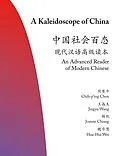
A Kaleidoscope of China is an advanced Chinese-language textbook that gives students a greater command of Chinese while deepening their understanding of the social and cultural issues facing China today. Geared to the unique needs of students with two or more years of instruction in modern Chinese, this book features a stimulating selection of articles and essays from major newspapers and periodicals in China, offering a revealing look at contemporary Chinese society. Topics include: buying a home versus having a child; consumer exports to America; depression; online dating; cell phones; empty-nest syndrome; fast food; the Virginia Tech massacre; medicine; the 2008 Sichuan earthquake; and global warming. Every selection is accompanied by a vocabulary list, exercises, and grammar notes.
No other Chinese-language textbook so effectively helps advanced students expand their language skills while immersing them in what is truly a kaleidoscope of today's China.
- Teaches advanced Chinese while providing a window into contemporary China
- Features selections from actual Chinese newspapers and periodicals
- Includes vocabulary lists, exercises, and grammar notes
- Ideal for students with two or more years of instruction in modern Chinese
Autorentext
Chih-p`ing Chou is professor of East Asian studies at Princeton University and director of the university's Chinese language and Princeton in Beijing programs. Joanne Chiang is senior lecturer in Chinese at Princeton. Jingyu Wang and Hua-Hui Wei are former lecturers in Chinese at Princeton.
Zusammenfassung
This is a penetrating reinterpretation and defense of Hegel's social theory as an alternative to reigning liberal notions of social justice. The eminent German philosopher Axel Honneth rereads Hegel's Philosophy of Right to show how it diagnoses the pathologies of the overcommitment to individual freedom that Honneth says underlies the ideas of Rawls and Habermas alike. Honneth argues that Hegel's theory contains an account of the psychological damage caused by placing too much emphasis on personal and moral freedom. Although these freedoms are crucial to the achievement of justice, they are insufficient and in themselves leave people vulnerable to loneliness, emptiness, and depression. Hegel argues that people must also find their freedom or "e;self-realization"e; through shared projects. Such projects involve the three institutions of ethical life--family, civil society, and the state--and provide the arena of a crucial third kind of freedom, which Honneth calls "e;communicative"e; freedom. A society is just only if it gives all of its members sufficient and equal opportunity to realize communicative freedom as well as personal and moral freedom.