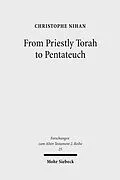
Christophe Nihan investigates the composition history of Leviticus, considered as a separate 'book' in the Torah/Pentateuch. In order to account for the distinct nature of the text, the author combines redaction criticism with comparative observations, cross-cultural studies in rituals, and inner-biblical exegesis. His analysis focuses on the sources used by the authors of Leviticus and the way in which they are re-interpreted in what is primarily a literary composition; on the book's relationship to the so-called 'priestly' literature in the Pentateuch; and, finally, on the place of Leviticus in the composition of the Torah as a whole. In particular, it is argued that Leviticus 1-16 (except for chapter 10) was initially composed as the conclusion to the priestly narrative in Genesis and Exodus. It reinterprets earlier ritual texts serving as check-lists for priests, transforming them into a revelation made to Moses on Mt Sinai for the whole community and thereby achieving the sacerdotal ideal of Israel as the 'priestly nation' of the world. Thus, reinterpretation of earlier sources in Lev 1-16 goes hand in hand with a redefinition of the community's identity that betrays the specific concerns of the priestly scribes in Jerusalem under Persian rule, probably during the reign of Darius I. The introduction of Lev 17-26 (27), for its part, betrays an entirely distinct historical and literary context. Through the systematic reception of Deuteronomy on one hand and the 'Book of the Covenant' (Ex 21-23) on the other, an attempt is made to close the revelation on Mt Sinai with a legislation that bridges the gap between P and other biblical codes at the time of the Torah's composition.
Né en 1972; 2005 doctorat; depuis 2021 professeur ordinaire en Ancien Testament à l'Université de Münster, spécialisé dans la littérature et la religion de l'Israël ancien dans son contexte ouest-sémitique.
Autorentext
Zusammenfassung
Christophe Nihan unternimmt eine Gesamtanalyse des Buches Leviticus und kommt zu dem Ergebnis, daß Lev 1-16 - unter Verarbeitung älterer Ritualtexte - als Abschluß des priesterlichen Werkes (P) komponiert wurde und die ideale Sicht Israels als die "priesterliche Nation" der Welt systematisch vorstellt. Lev 17-26 (27) hingegen sind einer späteren Redaktion zuzuschreiben, welche im Rahmen der Edition des Pentateuch um einen Ausgleich zwischen der Gesetzgebung von P, dem Bundesbuch und dem Deuteronomium bemüht ist. Die hier vorgelegten Ergebnisse sind für die Auslegung des Buches Leviticus sowie für die aktuelle Pentateuchdiskussion von erheblicher Relevanz.
Für dieses Werk erhielt Christophe Nihan den John Templeton Award for Theological Promise.
Né en 1972; 2005 doctorat; depuis 2021 professeur ordinaire en Ancien Testament à l'Université de Münster, spécialisé dans la littérature et la religion de l'Israël ancien dans son contexte ouest-sémitique.
Autorentext
Born 1972; studied Liberal Arts (Philosophy and French Literature) and Theology at the University of Lausanne, Switzerland; 2005 Dr. theol.; Lecturer in Old Testament/ Hebrew Bible at the University of Geneva, Switzerland.
Zusammenfassung
Christophe Nihan unternimmt eine Gesamtanalyse des Buches Leviticus und kommt zu dem Ergebnis, daß Lev 1-16 - unter Verarbeitung älterer Ritualtexte - als Abschluß des priesterlichen Werkes (P) komponiert wurde und die ideale Sicht Israels als die "priesterliche Nation" der Welt systematisch vorstellt. Lev 17-26 (27) hingegen sind einer späteren Redaktion zuzuschreiben, welche im Rahmen der Edition des Pentateuch um einen Ausgleich zwischen der Gesetzgebung von P, dem Bundesbuch und dem Deuteronomium bemüht ist. Die hier vorgelegten Ergebnisse sind für die Auslegung des Buches Leviticus sowie für die aktuelle Pentateuchdiskussion von erheblicher Relevanz.
Für dieses Werk erhielt Christophe Nihan den John Templeton Award for Theological Promise.
Titel
From Priestly Torah to Pentateuch
Untertitel
A Study in the Composition of the Book of Leviticus
Autor
EAN
9783161511233
ISBN
978-3-16-151123-3
Format
E-Book (pdf)
Hersteller
Herausgeber
Digitaler Kopierschutz
Adobe-DRM
Dateigrösse
2.86 MB
Anzahl Seiten
715
Jahr
2007
Untertitel
Englisch
Unerwartete Verzögerung
Ups, ein Fehler ist aufgetreten. Bitte versuchen Sie es später noch einmal.