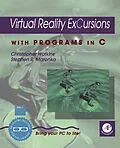
Virtual Reality Excursions with Programs in C provides the history, theory, principles and an account of the milestones in the development of virtual reality technology. The book is organized into five chapters. The first chapter explores the applications in the vast field of virtual reality. The second chapter presents a brief history of the field and its founders. Chapter 3 discusses human perception and how it works. Some interesting notes and much of the hot debate in the field are covered in Chapter 4. The fifth chapter describes many of the complexities involved in implementing virtual environments on real equipment. Computer scientists and programmers will find the book interesting.
Inhalt
List of Illustrations
Acknowledgments
Biographies
It's All in the Name
Initialization
Chapter 1-Virtual Reality Applications
Introduction
Section 1-Architectural Walkthroughs and Computer-Aided Design
Section 2-Augmentation and Decision Support
Section 3-Telecommunications and Virtual Interfaces
Molecular Studies
Teleoperation and Telepresence-Remote and Hazardous Workplaces
Section 4-Training
Section 5-Scientific Research
Section 6-Entertainment
Section 7-Medical Applications Using Virtual Reality
Computer-Aided Designed Treatment
Augmentation
Virtual Surgery
Remote Workplaces
Training
Application Notes
Chapter 2-From Whence Virtual Reality-A Brief and Incomplete History
Introduction
Section I-Classical History
In the Oral Tradition, Theater and the Dramatic Arts
In the Manner of Records and Writing
The Beginning of Electronic Communication
Morton Heilig and the Experience Theater
Section 2-The Age of Information Technology and the Dawn of Cyberspace
ARPA and the ARC
Douglas Engelbart and Intelligence Augmentation
Sketchpad-"The Most Important Program Ever Written"
Ivan and the Sword of Damocles
ARPAnet and the Internet
Xerox PARC
Myron Krueger and Responsive Environments
MIT's Arch-Mac and the Media Lab
Atari Research
NASA Ames Human Factors Research Division
Jaron Lanier and VPL
Frederick Brooks and UNC Chapel Hill
More History Related to VR
So What's the History of VR?
Chapter 3-From the Point of View
Introduction
Section 1-Of Sight
Section 2-Of Sound
Section 3-On Haptics
Perception
Chapter 4-Virtual Considerations
Introduction
Section 1-Desktop Versus Immersion (What's the View?)
The World through a Window
Boom-Mounted Displays
Immersion in a Room
Gloves and Goggles
Section 2-Future Possibilities
Architectural Walkthroughs and Computer-Aided Design
Augmentation
Augmenting the Handicapped
Telecommunications
Remote and Hazardous Workplaces
Computer Interfaces
Training
Scientific Exploration
Entertainment
Section 3-Virtual Reality and Society
The Internet (and the Matrix)
Virtual Identities
Virtual Community
NetLaw
Section 4-Wireheads-Living in a Virtual Environment
Living in Virtual Environments
VR as the Ultimate Drug
Reality Check
Section 5-Teledildonics (Cybersex) and Home Entertainment
Section 6-Simulator Sickness
Section 7-The Contributions of Science Fiction
The Classics
Cyberpunks
Final Considerations
Chapter 5-Technical Considerations for Virtual Reality Systems
Section 1-The Concept of a Virtual Reality System
A Brief, Yet Premature Overview of a VR System
Section 2-The Mathematics of Three-dimensional Computer Graphics (Geometry, Matrix Algebra, and Trigonometry)
A Discussion on Data Types and Structures
Basic Mathematics Functions and Macros
Comparison Functions and Macros
Swapping Functions and Macros
Power Functions
Pseudo-Random Number Generation Functions
Two-Dimensional Vector Functions and Macros
Three-Dimensional Vector Functions and Macros
3 x 3 Matrix Functions for Two-Dimensional Manipulations
4 x 4 Matrix Functions for Three-Dimensional Manipulations
How the Functions Work
Vector and Matrix Functions
Affine Transformation Routines
Pseudo-Random Number Generation
On to the Program Listings
Program Listings
Section 3-Database Hierarchy and Bubba
World Order
The Features of an Ideal Database Modeler
The Importance of Hierarchy in Database Construction
A Virtual Reality Modeler
Bubba's Database Hierarchy
Quick Review of Bubba's Graphics Primitives
Section 4-Filling Polygons and Antialising
The Polygon
Our Polygon Definitions
Color Filling the Convex Polygon
Drawing Adjacent Polygons
The Polygon Filling Routine
Image Quality and Spatial Aliasing
Anti-Aliasing
Motion Anti-Aliasing
Textures and Aliasing
Progressive Refinement
Program Listings
Section 5-Projecting Polygons
Parallel Projection
Perspective Projection
Program Listings
Section 6-Clipping Polygons
The Sutherland-Hodgman Polygon Algorithm used for Z-Clipping
The Liang-Barsky Polygon Algorithm used for Screen-Clipping
Viewports, Windows, and Screens
Program Listings
Section 7-Removing Hidden Polygons
The Backface Removal Algorithm
The Z Buffer Algorithm [Catmull 1974]
Scan Line Algorithms [Carpenter 1976]
The Painter's Algorithm [Newell 1972]
Position Comparison Tests for Polygons
The Binary Space Partitioning Algorithm [Fuchs 1980]
Program Listings
Section 8-Shading and Texturing Polygons
A Simple Shading Model
Texture Mapping and Textures
Bubba, Our Shading and Texturing
Section 9-Motion, Interaction, and Simulation
The Software
Any Simple Damped Motion Simulation
Mass-Spring Systems for Simulation
Particle Orbit Models for Simulation
More on Interaction
Program Listings
Section 10-Bringing It All Together to Make the Interactive Visualizer Called Bubba
Conceptual Program Flow for the Interactive Visualizer
Program Listings
Section 11-Stereo Vision and Our Anaglyph Glasses
Real 3-D
Our Anaglyph Glasses
Program Listings
Section 12-Other Rendering Methodologies
Ray Tracing
Radiosity
The Ideal Graphics Card
Conclusion
Modules for a Desktop Virtual Reality Software Development
Closing Comments
Appendix A-References
Network Reference List
FTP Sites
TELNET Sites
Discussions/Newsgroups
Internet
America Online
The Well
BIX
Bulletin Boards
Reference List of Companies
Appendix B-Illustrations
Image Credits
Color Inserts
Gray-Scale Inserts
Multimedia Technology Laboratory
Overview and Projects
Motion Interactive
3-D Scanner
Graphics, Visualization & Usability Center
Overview of the GVU Center
Overview of Virtual Environments at the GVU Center
Current Projects of the Virtual Environments Group at the GVU Center
The Phobia Project