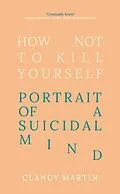
'Illuminating, riveting, and ? for those of us who are suffering, or know people who are ? potentially life-savingly helpful.' Scott Stossel
The last time Clancy Martin tried to kill himself was in his basement with a dog leash. He didn't write a note.
How Not to Kill Yourself is an affirmation of life by someone who has tried to end it multiple times. It's about standing in your bathroom every morning, gearing yourself up to die. It's about choosing to go on living anyway.
In an unflinching account of his darkest moments, Clancy Martin makes the case against suicide, drawing on the work of philosophers from Seneca to Jean Améry. Through critical inquiry and practical steps, we might yet answer our existential despair more freely ? and with a little more creativity.
Autorentext
Clancy Martin's work has appeared in The New Yorker, The Atlantic, Harper's, Esquire, Lapham's Quarterly, The Paris Review and many other prominent publications. A Guggenheim Fellow and Pushcart Prize winner, he has been a finalist for the National Magazine Award and won many fellowships and prizes. His books include the critically acclaimed How To Sell and Love and Lies. He holds joint appointments as Professor of Philosophy at The University of Missouri in Kansas City and at Ashoka University in New Delhi, and as Professor of Business Ethics at The Bloch School of Management at UMKC.
Klappentext
The last time Clancy Martin tried to kill himself was in his basement with a dog leash.
Weaving an intimate and unflinching account of his multiple suicide attempts with the personal experiences of those who have reached out to him over the years, Martin draws an insightful and, at times, comic portrait of the suicidal mind. He investigates the thinking of great writers who have attempted the unmentionable, from David Foster Wallace to Yiyun Li, and asks what philosophy has to say for and against suicide.
Both a disarming memoir and a cultural exploration of a hopeless state of mind, How Not to Kill Yourself allows us to grapple honestly with an enduring social taboo and shows that the desire to kill oneself ? like other self-destructive impulses ? is almost always temporary.