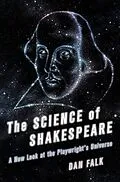
William Shakespeare lived at a remarkable time-a period we now recognize as the first phase of the Scientific Revolution. New ideas were transforming Western thought, the medieval was giving way to the modern, and the work of a few key figures hinted at the brave new world to come: the methodical and rational Galileo, the skeptical Montaigne, and-as Falk convincingly argues-Shakespeare, who observed human nature just as intently as the astronomers who studied the night sky. In The Science of Shakespeare, we meet a colorful cast of Renaissance thinkers, including Thomas Digges, who published the first English account of the "new astronomy" and lived in the same neighborhood as Shakespeare; Thomas Harriot-"England's Galileo"-who aimed a telescope at the night sky months ahead of his Italian counterpart; and Danish astronomer Tycho Brahe, whose observatory-castle stood within sight of Elsinore, chosen by Shakespeare as the setting for Hamlet-and whose family crest happened to include the names "Rosencrans" and "Guildensteren." And then there's Galileo himself: As Falk shows, his telescopic observations may have influenced one of Shakespeare's final works. Dan Falk's The Science of Shakespeare explores the connections between the famous playwright and the beginnings of the Scientific Revolution-and how, together, they changed the world forever.
Autorentext
DAN FALK has written for Smithsonian, New Scientist, Astronomy, Sky & Telescope, The Walrus and many other publications, and is the author of In Search of Time and Universe on a T-Shirt. He's been a regular contributor to Canadian public radio, and has won several international awards for his radio documentaries. Falk was a 2011-2012 Knight Science Journalism Fellow at MIT in Cambridge, Massachusetts. He lives in Toronto.
Inhalt
1. "Arise, fair sun . . ."
A Brief History of Cosmology
2. "He that is giddy thinks the world turns round . . ."
Nicolaus Copernicus, the Reluctant Reformer
3. "This majestical roof fretted with golden fire . . ."
Tycho Brahe and Thomas Digges
4. "These earthly godfathers of heaven’s lights . . ."
The Shadow of Copernicus and the Dawn of Science
5. "sorrow’s eye, glazed with blinding tears . . ."
The Rise of English Science and the Question of the Tudor Telescope
6. "Who is it that can tell me who I am?"
A Brief History of William Shakespeare
7. "More things in heaven and earth . . ."
The Science of Hamlet
8. ". . . a hawk from a handsaw . . ."
Reading Shakespeare, and Reading Into Shakespeare
9. "Does the world go round?"
Shakespeare and Galileo
10. "Treachers by spherical predominance . . ."
The Allure of Astrology
11. "Fair is foul, and foul is fair . . ."
Magic in the Age of Shakespeare
12. "A body yet distempered . . ."
Shakespeare and Medicine
13. "Drawn with a team of little atomi . . ."
Living in the Material World
14. "As flies to wanton boys . . ."
The Disappearing Gods
"They say miracles are past . . ."