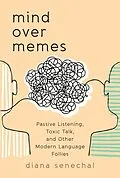
Too often our use of language has become lazy, frivolous, and even counterproductive. We rely on clichés and bromides to communicate in such a way that our intentions are lost or misinterpreted. In a culture of "takeaways" and buzzwords, it requires study and cunning to keep language alive. In Mind over Memes: Passive Listening, Toxic Talk, and Other Modern Language Follies, Diana Senechal examines words, concepts, and phrases that demand reappraisal. Targeting a variety of terms, the author contends that a "good fit" may not always be desirable; delivers a takedown of the adjective "toxic"; and argues that "social justice" must take its place among other justices. This book also includes a critique of our modern emphasis on quick answers and immediate utility. By scrutinizing words and phrases that serve contemporary fads and follies, this book stands up against the excesses of language and offers engaging alternatives. Drawing on literature, philosophy, social sciences, music, and technology, Senechal offers a rich framework to make fresh connections between topics. Combining sharp criticism, lyricism, and wit, Mind over Memes argues for judicious and imaginative speech.
Autorentext
By Diana Senechal
Inhalt
Acknowledgments Introduction Chapter 1: Take Away the Takeaway: The Problem with Pocketable Summaries Chapter 2: Change, Our False God: Questioning the Rhetoric of Reform Chapter 3: The Ubiquitous Team (Not Everything Has to Be Part of One) Chapter 4: Is Listening Passive? Chapter 5: Research Has Shown-Just What, Exactly? Chapter 6: Social and Unsocial Justice: How Different Kinds of Justice Combine Chapter 7: The Toxicity of "Toxic" Chapter 8: The Springs of Creativity: How Invention and Creation Require Subject Matter Chapter 9: In Praise of Mixed Mindsets: Why "Growth Mindset" May Not Always Be Ideal Chapter 10: What Do We Mean by "We"? Chapter 11: A Good Misfit: How Mismatches Can Enrich Our Work and Life Afterword Bibliography Index About the Author