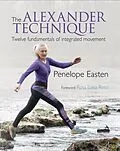
Our entire human structure is built for movement, for all aspects of life. This book offers a new theoretical framework for understanding integrated movement, based on the latest scientific models and practical explorations. Presenting a new interpretation of how Alexander developed his work, Easten covers twelve fundamentals of movement and shows how optimal movement is organised around sensory and spatial awareness, and our focus and goals. The book describes how to reawaken innate balanced movement possibilities. Up-to-date scientific research is woven into Alexander's concepts to give a whole picture of how the human body feels, perceives, and self-organises. Clarifying the functional anatomy that underpins the Alexander technique, this book explains how to utilize the power of the autonomic nervous system and spatial awareness to allow us to change old harmful movement habits and enable new body learning. Written accessibly and supported by illustrations and video demonstrations of techniques, this book is ideal for Alexander technique teachers and trainees, movement educators and somatic therapists.
Autorentext
Penelope Easten
Klappentext
All aspects of life involve movement. This book offers a broad, new theoretical framework of how integrated movement occurs, with ideas from recent science, and practical explorations. Aimed at teachers and trainees of the Alexander technique, and all movement educators and somatic therapists, it uses accessible language to enable experiential learning. The explorations are simple techniques that build to enable practitioners both to look after themselves in life and practice, and to use with clients to help them understand and integrate what we offer them. The book takes an evolutionary theme - what movement capacity we have lost in Western culture and how we can re-access it by reawakening older, more balanced movement patterns. The twelve fundamentals of integrated movement described are all practical: biomechanics is one structural fundamental, while many others are aspects of perception and thinking. These are much more part of movement than is mostly realised, because optimal movement is organised around our awareness, focus and goals. The book emerges out of lessons taken between 1990 and 1994 with Miss Goldie, who worked alongside Alexander for thirty years and was closest to him. It presents a new interpretation of how Alexander developed the technique, and what happened next. The explorations recapture the essence of her teaching, and discovers the full scope of methods Alexander must have used to work on himself. The body of the book combines theory with practical explorations that take the reader step by step back to integrated movement. Part 1 introduces the twelve fundamentals, and how natural breathing emerges when they work together; Part 2 uses body-play, conscious guidance and control and physical pulls to bring all the musculature back into play, while Part 3 explores letting previously unknown integrated movements emerge out of a quiet system. The new scientific theories described will help the reader accept these very different physical experiences. These include left / right brain models; the concept that all our body's intelligence centres (including the brain) are cooperative networks and not hierarchical; the Polyvagal theory and attachment theory; the two visual streams theory; spinal engine theory, tensegrity, and a new model of postural alignment; woven together to explain how we can live in a flow of dynamic balance.