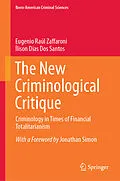
This book examines the rise of financial totalitarianism and its profound implications for criminal justice and criminological theory. It explores how the concentration of wealth and social exclusion, driven by corporate CEOs, has altered the role of politics in shaping criminal justice systems. The text argues that these shifts have given rise to a dystopian criminology, marked by a focus on total security, extreme prevention, zero tolerance policies, and pervasive surveillance. It critically assesses how these developments contribute to the criminalization of dissent, foster societal fears of outsiders, and institutionalize ethnic and cultural discrimination, all while maintaining a façade of administrative control. Drawing on historical and contemporary analysis, the book offers a framework for rethinking criminology in the context of financial and political power, advocating for a more critical approach to understanding crime, punishment, and justice in an increasingly unequal world.
Autorentext
Eugenio Raúl Zaffaroni is a distinguished Ibero-American jurist, renowned for his contributions to criminology, criminal law, and human rights. He served as a Justice of the Supreme Court of Argentina and as a Judge of the Inter-American Court of Human Rights. He also held the position of General Director of the United Nations Latin American Institute for the Prevention of Crime and the Treatment of Offenders (ILANUD). Academically, he is a Professor Emeritus at the University of Buenos Aires, where he chaired the Department of Criminal Law and Criminology for several decades. He is the author of numerous influential works, including the five-volume Tratado de Derecho Penal and La nueva crítica criminológica (co-authored with Ílison Dias Dos Santos), both widely disseminated in multiple languages. Throughout his career, he has received more than fifty honorary doctorates from prestigious universities across Latin America and Europe. In 2009, he was awarded the Stockholm Prize in Criminology for his research on genocide, often referred to as the "Nobel Prize of Criminology." His scholarship has significantly shaped the field of criminal sciences in Latin America and Europe, and he is regarded as a central figure in the development of contemporary criminology and criminal law, noted for his critical and humanistic approach to the interpretation and application of penal law.
Ílison Dias Dos Santos is Ramón y Cajal Research Professor of Criminal Law at the Department of Legal Sciences of the University of Alcalá (Madrid, Spain). He previously held a Margarita Salas Postdoctoral Fellowship, carrying out postdoctoral research at the University of Barcelona and serving as a Gastwissenschaftler (postdoctoral fellow) at Humboldt University of Berlin. He also served as a Collaborating Professor in the Master's Program in Criminology, Criminal Policy, and Sociology of Criminal Law at the University of Barcelona. He holds a PhD in Law from the University of Salamanca (Summa Cum Laude with International Distinction), where he received the Extraordinary Doctorate Award. He has been awarded several competitive research fellowships, enabling academic stays in Brazil, Spain, Germany, Italy, and Argentina, and has contributed to interdisciplinary research projects across Europe and Latin America. His research focuses on criminal law, criminology, and criminal policy, with a particular emphasis on critical and interdisciplinary approaches to punitive power. He is the author of numerous academic articles and books, including The New Critical Criminology (with Eugenio Raúl Zaffaroni) and Aporophobia and Punitive Power. He serves as Academic Editor of the Ibero-American Criminal Sciences book series (Springer Nature) and the Reflexiones en Derecho Penal y Criminología book series (BdeF-Reus). He is a founding member and former president of the Center for Criminal Sciences at the Federal University of Bahia. He is affiliated with the Istituto di Studi Penalistici at the University of Calabria, serves on the editorial boards of specialized journals, and actively collaborates with international academic networks.