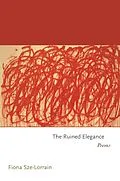
A lyrical collection that explores the interplay between poetry and history
In her new collection, Fiona Sze-Lorrain offers a nuanced yet dynamic vision of humanity marked by perils, surprises, and the transcendence of a "ruined elegance." Through an intercultural journey that traces lives, encounters, exiles, and memories from France, America, and Asia, the poet explores a rich array of historical and literary allusions to European masters, Asian sources, and American influences. With candor and humor, each lyrical foray is sensitive to silence and experience: "I want to honor / the invisible. I'll use the fog to see white peaches." There are haunting narratives from a World War II concentration camp, the Stalinist Terror, and a persecuted Tibet during the Cultural Revolution. There are also poems that take as their point of departure writings, paintings, sketches, photographs, and music by Gu Cheng, Giorgio Caproni, Bonnard, Hiroshige, Gao Xingjian, Kertész, and Debussy, among others. Grounded in the sensual, these poems probe existential questionings through inspirations from nature and the impermanent earth. Described by the Los Angeles Review of Books as "a high lyricist who refuses to resort to mere lyricism in order to articulate her experience," Sze-Lorrain renews her faith in music and poetic language by addressing the opposing aesthetics of "ruins" and "elegance," and how the experience of both defies judgment.
Autorentext
Fiona Sze-Lorrain is a poet, literary translator, editor, and zheng harpist. The author of two previous books of poetry in English, My Funeral Gondola and Water the Moon, she also writes and translates in French and Chinese. She lives in Paris.
Zusammenfassung
A lyrical collection that explores the interplay between poetry and historyIn her new collection, Fiona Sze-Lorrain offers a nuanced yet dynamic vision of humanity marked by perils, surprises, and the transcendence of a "e;ruined elegance."e; Through an intercultural journey that traces lives, encounters, exiles, and memories from France, America, and Asia, the poet explores a rich array of historical and literary allusions to European masters, Asian sources, and American influences. With candor and humor, each lyrical foray is sensitive to silence and experience: "e;I want to honor / the invisible. I'll use the fog to see white peaches."e; There are haunting narratives from a World War II concentration camp, the Stalinist Terror, and a persecuted Tibet during the Cultural Revolution. There are also poems that take as their point of departure writings, paintings, sketches, photographs, and music by Gu Cheng, Giorgio Caproni, Bonnard, Hiroshige, Gao Xingjian, Kertesz, and Debussy, among others. Grounded in the sensual, these poems probe existential questionings through inspirations from nature and the impermanent earth. Described by the Los Angeles Review of Books as "e;a high lyricist who refuses to resort to mere lyricism in order to articulate her experience,"e; Sze-Lorrain renews her faith in music and poetic language by addressing the opposing aesthetics of "e;ruins"e; and "e;elegance,"e; and how the experience of both defies judgment.
Inhalt
I WRONG EPIC
Given Silence 3
Towering 4
I Wait for the Ruined Elegance 5
Back from the Aegean Sea 6
In the Thick of It 7
Ionian Supper 9
Partita, but Nothing to Do with Bach 10
Few Days before Christmas 13
II IN A GODLESS TIME
Beginning 17
Spring Massacre 18
Mausoleum 19
Backstage 20
Day Seven 21
Center of a Journey 22
Am I What the Lake Gave Me 23
Meditation 24
Dusty Citadel 25
III THE BOOK, A SIMPLER GRAVE
To Whom It May Concern 29
Granted Asylum 31
Against Prologue 32
To Survive When It Must 33
Midnight Almanac 34
Yield, Please 36
Anna Akhmatova, or the Thoughts She Didn't Write 37
An Uprising Committed to Longhand 38
Geneviève de Gaulle-Anthonioz took more than fifty years before writing Ravensbrück down in La Traversée de la nuit 39
Chosen by the Narrator 40
Cantabile (ma stonato) 41
IV CAUGHT IN DEFIANCE
Transparent 45
Ink Painting from the Joseon Dynasty 46
What's Left of a Sijo 47
Chiaroscuro, 2 a.m. 48
Bonnard's Naked Wife Leaving the Bathtub 49
La Chambre d'écoute 51
Three Moves, Clockwise 52
Om dhrung svaha 54
My Hiroshige 55
Peintre 56
Jardins sous la pluie 57
Notes 59
Acknowledgments 61