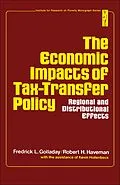
The Economic Impacts of Tax-Transfer Policy: Regional and Distributional Effects deals with evaluating proposed income-transfer policies through tax modeling. The book analyzes the direct and indirect effects of two variants of a negative income tax plan. These are the standard negative income tax and the Family Assistance Plan. By studying the indirect effects of income-maintenance programs on industries, occupations, and different regions, the authors point to understanding the effectiveness of alternative income-maintenance programs. Proposed changes in national taxes and transfer policies aim to achieve income redistribution. In their studies and models, the authors noted that the full impact of these tax policies throughout the income spectra covering different income classes, industries, occupations, and regions is different from that gathered from observations involving the direct effects of these schemes. The authors cite some policy implications resulting from their study, such as the redistributional impacts of direct tax-transfer scheme are not as efficient as expected and that increasing the demand for low-skilled workers and improving their job qualities is one way of improving income distribution. The text is valuable for economists and government policymakers in the finance and labor sectors, as well as for sociologists and political economists.
Inhalt
List of Tables
Foreword
Preface
Acknowledgments
1 Income Transfers and Income Redistribution
2 Two Tax-Transfer Policy Proposals - The Basis for a Simulation Exercise
Two Tax-Transfer Proposals
Financing the Transfer Proposals
on Evaluating Tax-Transfer Policies
3 Modeling the Microeconomic Effects of Tax-Transfer Policy: Conceptual Issues
Structure of the Model
Components of the Model
The Consumption Expenditure Module
4 Modeling the Microeconomic Effects of Tax-Transfer Policy: Empirical Issues
Empirical Implementation of the Model
The Model in Notational Form
5 From First-Round to Final Income Redistribution: How Much Do Antipoverty Transfers Equalize Incomes?
First-Round Distributional Effects
Induced Distributional Effects
6 Between First-Round and Final Income Redistribution: The Process of Economic Adjustment
Effects of FAP and NIT on Consumption Expenditures
Effects of FAP and NIT on Gross Output
Effects of FAP and NIT on Labor Demand
7 Summary and Conclusions
A Brief Summary of Empirical Findings
Some Caveats
Some Policy Implications
Appendix A Calculation of Benefits From Income-Transfer Programs
Negative Income Tax (NIT)
Family Assistance Plan (FAP)
Appendix B Simulated State Supplementary Welfare Payments Under FAP
Appendix C Simulated Tax Revenues Required to Finance Transfer Programs
Appendix D Estimation of Marginal Budget Shares
A Piecewise Semi-Log Expenditure-Income Regression Model
Calculation of Commodity-Specific Estimates of Marginal Consumption Propensity
Estimation of Vectors of Marginal Budget Shares
Appendix E Reconciliation of Consumer Expenditure Categories with Input-Output Categories
Appendix F The Formation of Socioeconomic Groups for Expenditure Models Based on Normal Income
The Data
Grouping the Observations
The Socioeconomic Groups and Their Economic Characteristics
Appendix G Estimation of Ratios of Employment to Output, by Industry and Region
Appendix H Statistical Reliability of Regional Aggregation
Appendix I Detailed Occupation Categories
Appendix J Estimation of Regional Matrices of Occupation by Earnings Class
Appendix K Impacts of Income-Transfer Policies on Gross Output, by Detailed Industry
Appendix L Impacts of Income-Transfer Policies on Labor Demand, by Detailed Occupational Category
Subject Index