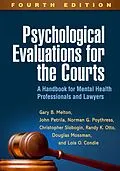
Practitioners and students in clinical and forensic psychology, social work, family therapy and counseling, and psychiatry; legal professionals and students. Serves as a text in graduate-level courses such as Forensic Psychology, Psychological Testing, and Social Work and the Law.
Autorentext
Gary B. Melton, PhD, until his death in 2020, was Associate Director for Community Development and Social Policy at the Kempe Center for the Prevention and Treatment of Child Abuse and Neglect, Professor of Pediatrics, and Professor of Community and Behavioral Health at the University of Colorado Anschutz Medical Campus. A champion for children's mental health, Dr. Melton received Distinguished Contributions Awards from the American Professional Society on the Abuse of Children, the American Psychological Association (four times, a unique achievement), the American Psychological Foundation, and Prevent Child Abuse America, among other organizations. The author of more than 350 publications, he was founding editor-in-chief of the International Journal on Child Maltreatment and senior editor of the American Journal of Orthopsychiatry. In his honor, the Global Alliance for Behavioral Health and Social Justice established the Gary B. Melton Award in 2020. John Petrila, JD, LLM, is Vice President of Adult Policy at Meadows Mental Health Policy Institute. Previously, he was Chair and Professor of Health Policy and Management at the University of South Florida College of Public Health. He is a recipient of a Fulbright Scholarship and of the University of South Florida President's Faculty Excellence Award. Dr. Petrila's research interests include the diversion of people with mental illnesses from the justice system, coercion, and strategies to reduce recidivism of heavy users of the treatment and justice systems. Recent papers focus on emergency hospitalizations of people with mental illnesses, national review of emergency civil commitment legislation, and the current status of the Americans with Disabilities Act. Norman G. Poythress, PhD, is Professor Emeritus in the Department of Mental Health Law and Policy at the University of South Florida, where he served as Research Director from 1990 to 2010. He is a past president of the American Psychology-Law Society, which honored him with its Award for Distinguished Contributions to Psychology and Law. He is also a recipient of the University of South Florida President's Faculty Excellence Award. Dr. Poythress has published more than 100 research articles and book chapters on forensic assessment, mental health courts, research ethics, and psychopathic behavior. Christopher Slobogin, JD, LLM, is Milton Underwood Chair at Vanderbilt University Law School. He is the first law professor to receive Distinguished Contribution Awards from both the American Psychology-Law Society and the American Board of Forensic Psychology. Mr. Slobogin has published over 150 works on mental health law and criminal justice, and is currently one of the 40 most cited law professors in the country. He recently served as chair of the task force revising the American Bar Association's Criminal Justice Mental Health Standards, and was also a Reporter for the ABA's Task Force on Mental Disability and the Death Penalty. Randy K. Otto, PhD, ABPP, is Associate Professor in the Department of Mental Health Law and Policy at the University of South Florida, where he has been on the faculty since 1989. He also teaches in the Departments of Psychology and Criminology. Board-certified in clinical and forensic psychology, Dr. Otto has served as president of the American Psychology-Law Society, the American Board of Forensic Psychology, and the American Board of Professional Psychology. His contributions to forensic psychological assessment have been recognized with awards from the American Academy of Forensic Psychology and the forensic division of the New York State Psychological Association. Douglas Mossman, MD, until his death in 2018, was Professor of Clinical Psychiatry and Program Director of the Forensic Psychiatry Fellowship at the University of Cincinnati College of Medicine. A board-certified general and forensic psychiatrist and Distinguished Life Fellow of the American Psychiatric Association, Dr. Mossman authored more than 180 publications on diverse issues in medicine and law, including competence, judgment models, malingering measures, psychotropic medication, malpractice, psychiatric ethics, and novel mathematical approaches to diagnostic assessment. He received the American Psychiatric Association's Manfred S. Guttmacher Award for outstanding contributions to the literature on forensic psychiatry. Hundreds of scientific and legal works cite his 1994 article, "Assessing Predictions of Violence: Being Accurate about Accuracy." Lois O. Condie, PhD, ABPP, is affiliated with the Department of Neurology at Boston Children's Hospital and is Assistant Professor of Psychology in Psychiatry at Harvard Medical School. Dr. Condie is board-certified in neuropsychology, clinical psychology, and forensic psychology. She has received citations and awards from the Social Security Administration, the American Board of Forensic Psychology, the American Academy of Forensic Psychology, and the American Board of Professional Psychology. Her research focuses on assessments and entitlement legislation for children with neurodevelopmental and other disorders, services for vulnerable populations internationally, psychological and legal conceptions of privacy, and ethics and standards of practice.
Inhalt
I. General Considerations 1. Law and the Mental Health Professions: An Uneasy Alliance 1.01. The Context for Law and Behavioral Science 1.02. Some Preliminary Problems in Law and Mental Health 1.03. Paradigm Conflicts 1.04. Should Mental Health Professionals Be Considered Experts? 1.05. Which Professionals Should Be Considered Experts? 1.06. Conclusion Bibliography 2. An Overview of the Legal System: Sources of Law, the Court System, and the Adjudicative Process 2.01. Introduction 2.02. Sources of Law 2.03. The Court System 2.04. The Adjudicative Process 2.05. Conclusion: The Interplay of Systems Bibliography 3. The Nature and Method of Forensic Assessment 3.01. Introduction 3.02. Distinctions between Therapeutic and Forensic Assessment 3.03. Testing and Assessment Procedures 3.04. Archival and Third-Party Information 3.05. Amnesia 3.06. Assessment of Response Style 3.07. Challenges to the Basis of Expert Testimony 3.08. Conclusion Bibliography 4. Constitutional, Common-Law, and Ethical Contours of the Evaluation Process: The Mental Health Professional as Double Agent 4.01. Introduction 4.02. The Fifth Amendment and the Right to Remain Silent 4.03. The Right to Counsel 4.04. Common-Law and Statutory Duties of the Evaluator 4.05. Ethical Considerations in the Evaluation Process 4.06. Summary: Competence in Forensic Practice Bibliography 5. Managing Public and Private Forensic Services 5.01. Introduction 5.02. The Case for Specialization 5.03. Types of Evaluation Systems 5.05. Effective Diffusion of Behavioral Science Research 5.06. Operating a Forensic Practice Bibliography II. The Criminal Process 6. Competence to Proceed 6.01. Introduction 6.02. The Legal Standard 6.03. Procedural Issues 6.04. Disposition of Incompetent Defendants 6.05. Competence during Proceedings Other Than Trial or Plea Hearings 6.06. Research Relating to Competence Evaluations 6.07. Structured Evaluation Formats 6.08. Special Populations 6.09. Guidelines for Evaluation 6.10. Conclusion Bibliography 7. Other Competencies in the Criminal Process 7.01. Introduction 7.02. Competence to Consent to a Search or Seizure 7.03. Competence to Exercise the Right to Remain Silent 7.04. Competence to Plead Guilty 7.05. Competence to Waive the Right to Counsel and to Represent Oneself 7.06. Competence to Refuse an Insanity Defe…
Titel
Psychological Evaluations for the Courts
Untertitel
A Handbook for Mental Health Professionals and Lawyers
Autor
EAN
9781462535538
Format
E-Book (epub)
Hersteller
Veröffentlichung
04.12.2017
Digitaler Kopierschutz
frei
Anzahl Seiten
964
Laden...
Unerwartete Verzögerung
Ups, ein Fehler ist aufgetreten. Bitte versuchen Sie es später noch einmal.