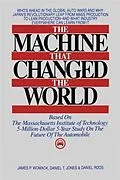
When The Machine That Changed the World was first published in 1990, Toyota was half the size of General Motors. Today Toyota is passing GM as the world's largest auto maker and is the most consistently successful global enterprise of the past fifty years. This management classic was the first book to reveal Toyota's lean production system that is the basis for its enduring success.
Now reissued with a new Foreword and Afterword, Machine contrasts two fundamentally different business systems -- lean versus mass, two very different ways of thinking about how humans work together to create value. Based on the largest and most thorough study ever undertaken of any industry -- MIT's five-year, fourteen-country International Motor Vehicle Program -- this book describes the entire managerial system of lean production.
Nearly twenty years ago, Womack, Jones, and Roos provided a comprehensive description of the entire lean system. They exhaustively documented its advantages over the mass production model pioneered by General Motors and predicted that lean production would eventually triumph. Indeed, they argued that it would triumph not just in manufacturing but in every value-creating activity from health care to retail to distribution.
Today The Machine That Changed the World provides enduring and essential guidance to managers and leaders in every industry seeking to transform traditional enterprises into exemplars of lean success.
Autorentext
James P. Womack is the president and founder of the Lean Enterprise Institute (www.lean.org), a nonprofit education and research organization based in Brookline, Massachusetts.
Daniel T. Jones is the chairman and founder of the Lean Enterprise Academy (www.leanuk.org), a nonprofit education and research organization based in the UK.
Inhalt
FOREWORD 2007. WHY TOYOTA WON: A TALE OF TWO BUSINESS SYSTEMS
BEFORE YOU BEGIN THIS BOOK
THE INDUSTRY OF INDUSTRIES IN TRANSITION
THE RISE AND FALL OF MASS PRODUCTION
THE RISE OF LEAN PRODUCTION
RUNNING THE FACTORY
DESIGNING THE CAR
COORDINATING THE SUPPLY CHAIN
DEALING WITH CUSTOMERS
MANAGING THE LEAN ENTERPRISE
CONFUSION ABOUT DIFFUSION
COMPLETING THE TRANSITION
EPILOGUE
AFTERWORD 2007. WHAT WE HAVE LEARNED ABOUT LEAN PRODUCTION SINCE 1990
NOTES
APPENDIXES
INTERNATIONAL MOTOR VEHICLE PROGRAM SPONSORING ORGANIZATIONS
INTERNATIONAL MOTOR VEHICLE PROGRAM RESEARCH AFFILIATE TEAM
IMVP PROGRAM AND FORUM PARTICIPANTS
ACKNOWLEDGMENTS
INDEX