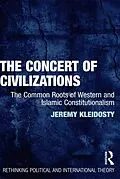
Are Western and Islamic political and constitutional ideas truly predestined for civilizational clash? In order to understand this controversy The Concert of Civilizations begins by deriving and redefining a definition of constitutionalism that is suitable for comparative, cross-cultural analysis. The rule of law, reflection of national character, and the clear delineation and limitation of governmental power are used as lenses through which thinkers like Cicero, Montesquieu, and the authors of The Federalist Papers can be read alongside al-Farabi, ibn Khaldun, and the Ottoman Tanzimat decrees. Bridging the civilizational divide is a chapter comparing the Magna Carta with Muhammad'sConstitution of Medina, as both documents can be seen as foundational within their traditions. For the first time in political theory, this text also provides a sustained, detailed analysis of Khayr al-Din al-Tunisi's book The Surest Path, which explains his fusion of Muslim and Western ideas in his writing of Tunisia's first modern constitution, which is also the first constitution for a majority-Muslim state. Finally, the book discusses the Arab Spring through a brief overview of the revolutions in Egypt, Libya, and Tunisia, and offers some early thoughts about Tunisia's uniquely successful revolution.
Autorentext
Jeremy Kleidosty is currently a post-doctoral fellow on the Academy of Finland project Political Power in the Early Modern European and Islamic Worlds, at the University of Jyvÿskylÿ, Finland. He is working on a new book that profiles Tunisia's constitutional history and that of its constitutional father, Khayr al-Din al-Tunisi. Previously, he taught International Relations at the University of Sharjah, in the United Arab Emirates. He gained his PhD in International Relations from the University of St Andrews, Scotland in 2013 and researches constitutionalism and political theory. His work particularly aims to foster dialogue and fruitful avenues of reconciling different political traditions in a globalized world.
Inhalt
Introduction; Chapter 1 Constitutional Conversations-Alternative Models for the Challenge of Civilizational Conflict; Chapter 2 Western Constitutionalism-Universal Norms or Contingent Cultural Concepts; Chapter 3 From Medina to Runnymede-Comparing the Foundational Legacies of the Constitution of Medina and the Magna Carta; Chapter 4 Comparing Constitutionalisms-Is there an Islamic Constitutionalism?; Chapter 5 Constitutional Conversations-The Fusing of Political Tradition in Khayr al-Din al-Tunisi's The Surest Path; Chapter 6 The Arab Spring-Constitutional Thought in Contested Political Space, Questions and Conclusions;