'Avery weaves together diverse theoretical strands to examine how disability works at disjunctures in families and institutions. Avery also shows us how science can help in doing applied anthropology and in thinking ethically about social problems.'
-Daniel Lende, Associate Professor of Anthropology, University of South Florida, USA
'Conducting ethnographic research across significant cognitive and communicative difference poses formidable challenges- methodological, ethical and interpretive. Jocelyn Avery takes up these challenges with aplomb. Through close attention to shared embodied experience, she suggests convincingly that the countless little injustices to which students with severe intellectual difficulties are subjected are deeply significant, affecting their well-being and that of their society.'
-Elizabeth Fein, Assistant Professor of Psychology, Duquesne University, USA'A must-read for students and scholars in anthropology and disability studies. Avery combines personal experience of caregiving with her knowledge of embodiment to bring clarity to the ways embodied others are affected by their disabling environment and those they share it with. As a carer myself, this book will help me be a better advocate for my son.'
-Aaron J. Jackson, PhD, University of Melbourne, Australia
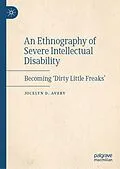
In this ethnographic investigation of a special education needs college in Australia, Jocelyn D. Avery explores how the self-identity of people with severe intellectual disabilities is influenced by carers and support people in their lives. Employing theoretical foundations of self-identity and embodiment and drawing largely on Mary Douglas's (1996) notions of ritual and hygiene, purity and danger, Avery argues that students in this environment are treated as though they exist in a vacuum, rather than a highly complex social environment: strategies to 'contain' their difficult selves ultimately lead to continued confinement, as if the students themselves were 'contaminated'. In the midst of this much-needed ethnography, Avery meditates on her own role: matters of consent, communication, and cooperation pose a challenge to anthropological engagement with severe intellectual disability, but researcher ethics and positionality have their own difficulties. The reflection provided here will provide a guide for future researchers to sensitively engage with people with disability.
Autorentext
Jocelyn D. Avery, PhD, is an independent anthropological researcher, focusing on intellectual disability.
Zusammenfassung
In this ethnographic investigation of a special education needs college in Australia, Jocelyn D. Avery explores how the self-identity of people with severe intellectual identities is influenced by carers and support people in their lives. Employing theoretical foundations of self-identity and embodiment and drawing largely on Mary Douglas's (1996) notions of ritual and hygiene, purity and danger, Avery argues that students in this environment are treated as though they exist in a vacuum, rather than a highly complex social environment: strategies to 'contain' their difficult selves ultimately lead to continued confinement, as if the students themselves were 'contaminated'. In the midst of this much-needed ethnography, Avery meditates on her own role: matters of consent, communication, and cooperation pose a challenge to anthropological engagement with severe intellectual disability, but researcher ethics and positionality have their own difficulties. The reflection provided here will provide a guide for future researchers to sensitively engage with people with disability.
Inhalt
Chapter 1: Orientation