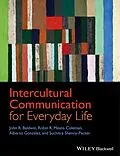
Written for students studying intercultural communication for thefirst time, this textbook gives a thorough introduction to inter-and cross-cultural concepts with a focus on practical applicationand social action.
* Provides a thorough introduction to inter- and cross-culturalconcepts for beginning students with a focus on practicalapplication and social action
* Defines "communication" broadly using authors froma variety of sub disciplines and incorporating scientific,humanistic, and critical theory
* Constructs a complex version of culture using examples fromaround the world that represent a variety of differences, includingage, sex, race, religion, and sexual orientation
* Promotes civic engagement with cues toward individualintercultural effectiveness and giving back to the community insocially relevant ways
* Weaves pedagogy throughout the text with student-centeredexamples, text boxes, applications, critical thinking questions, aglossary of key terms, and online resources for students andinstructors
* Online resources for students and instructorsavailable upon publication at www.wiley.com/go/baldwin
Autorentext
John R. Baldwin is Professor of Communication at Illinois State University.
Robin R. Means Coleman is Associate Professor in the Departments of Communication Studies and Afroamerican and African Studies at the University of Michigan.
Alberto González is Professor of Communication at Bowling Green State University.
Suchitra Shenoy-Packer is Assistant Professor of Communication Studies at DePaul University.
Klappentext
"This broad introduction to intercultural communication, uncommon for its inclusion of ethics, civic engagement, and global media, also integrates popular culture examples likely to appeal to students." Wendy Leeds-Hurwitz, Villanova University, USA
"Well written, lively, and practical, Intercultural Communication for Everyday Life is the first intercultural communication textbook to challenge students to think critically about civic and political engagement in intercultural contexts. Bravo!" Robert Shuter, Diederich College of Communication, Marquette University, USA
"Baldwin, Means Coleman, González, and Shenoy-Packer have written an intercultural communication text that starts with a rich conceptualization of culture while, at the same time, focusing students on basic concepts, key terms, and frameworks in a rigorous but approachable style." Michael Hecht, The Pennsylvania State University, USA
Even if you never leave your own country, you cannot help but cross paths with people of different cultures in our connected and fast-paced world. Written for students studying intercultural communication for the first time, this textbook gives a thorough introduction to inter- and cross-cultural concepts with a focus on practical application and social action. The book brings together a group of authors from diverse backgrounds (rhetoric, media studies, organizational approaches, and interpersonal communication) to present a broad view of "communication" that incorporates scientific, humanistic, and critical theories.
The text highlights and critiques key theory and research in an accessible and engaging manner but is written with a complex version of culture in mind. It incorporates examples from around the world that represent a variety of differences, including age, sex, race, religion, and sexual orientation. Pedagogy is woven throughout the text with student-centered examples, applications, critical thinking questions, and a glossary of key terms, and it extends beyond the book with online resources for both students and instructors. The text not only helps students understand other cultures, but it also encourages them to be more aware of and civically engaged in their own culture with suggestions for individual intercultural effectiveness and giving back to the community in socially relevant ways.
Online resources for students and instructors can be found at www.wiley.com/go/baldwin.
Zusammenfassung
Written for students studying intercultural communication for the first time, this textbook gives a thorough introduction to inter- and cross-cultural concepts with a focus on practical application and social action.
- Provides a thorough introduction to inter- and cross-cultural concepts for beginning students with a focus on practical application and social action
- Defines communication broadly using authors from a variety of sub disciplines and incorporating scientific, humanistic, and critical theory
- Constructs a complex version of culture using examples from around the world that represent a variety of differences, including age, sex, race, religion, and sexual orientation
- Promotes civic engagement with cues toward individual intercultural effectiveness and giving back to the community in socially relevant ways
- Weaves pedagogy throughout the text with student-centered examples, text boxes, applications, critical thinking questions, a glossary of key terms, and online resources for students and instructors
- Online resources for students and instructors available upon publication at www.wiley.com/go/baldwin
Inhalt
Preface xi
Acknowledgements xv
About the website xvi
Walk through xvii
Part One Foundations 1
1 A rationale for studying intercultural communication: Why should we know about other cultures? 3
Building a rationale: Why do we need to know about intercultural communication? 5
The personal growth motive 5
The social responsibility motive 6
The economic motive 8
The cross-cultural travel motive 10
The media motive 13
Challenges of studying intercultural communication 15
The history and focus of intercultural communication: Where did we come from? 16
Summary 19
Key terms 19
Discussion questions 20
Action points 20
For more information 20
2 Action, ethics, and research: How can I make a difference? 24
Muslim veils in French schools: How can we determine right from wrong in intercultural situations? 26
Ethics and morality 27
Determining a universal ethical stance 28
Ethical relativism 29
" Not in our town:" What is the role of intercultural communication in civic engagement? 30
Political and civic engagement 31
Defending civic and political engagement among college students 32
Doing civic engagement 34
How can we do responsible cultural research? 35
Assumptions that guide cultural research 36
Approaches to studying culture and communication 36
Differences of focus in culture-and communication studies 41
Summary 42
Key terms 43
Discussion questions 43
Action points 44
For more information 44
3 Origins: Where does our "culture" come from? 47
The relationship between communication and culture: How do they inform each other? 49
Defining communication 49
The relationship between communication and culture 51
Defining culture: How can we define culture-and what are the implications of our definition? 52
Aspects and elements of culture: What is culture like? 55
Aspects of culture 55
Characteristics of culture 56
A model of interaction: How can we best understand intercultural and intergroup communication? 61
Summary 63
Key terms 64
Discussion questions 64
Action points 65
For more information 65
Part Two Elements 69
4…