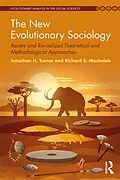
For decades, evolutionary analysis was overlooked or altogether ignored by sociologists. Fears and biases persisted nearly a century after Auguste Comte gave the discipline its name, as did concerns that its effect would only reduce sociology to another discipline - whether biology, psychology, or economics. Worse, apprehension that the application of evolutionary theory would encourage heightened perceptions of racism, sexism, ethnocentrism and reductionism pervaded.
Turner and Machalek argue instead for a new embrace of biology and evolutionary analysis. Sociology, from its very beginnings in the early 19th century, has always been concerned with the study of evolution, particularly the transformation of societies from simple to ever-more complex forms. By comprehensively reviewing the original ways that sociologists applied evolutionary theory and examining the recent renewal and expansion of these early approaches, the authors confront the challenges posed by biology, neuroscience, and psychology to distinct evolutionary approaches within sociology. They emerge with key theoretical and methodological discoveries that demonstrate the critical - and compelling - case for a dramatically enriched sociology that incorporates all forms of comparative evolutionary analysis to its canon and study of sociocultural phenomena.
Autorentext
Jonathan H. Turner is 38th University Professor of the University of California System; Research Professor, University of California, Santa Barbara, and Distinguished Professor at the University of California, Riverside. He is also Director of the Institute for Theoretical Social Science, Santa Barbara, CA, USA. He is the author of hundreds of research articles and the author of more than 40 distinguished books, including most recently, The New Evolutionary Sociology (with Richard Machalek).
Richard Machalek is Professor Emeritus of Sociology at the University of Wyoming. His work addresses the evolution of social behavior among both human and non-human species. He analyzes phenomena such as the evolution of societal complexity among both humans and the eusocial insects, the evolution of expropriative social behaviors across species lines, emergent properties of both human and nonhuman societies, the evolved human psychology implicated in reciprocity and exchange, and theoretical points of convergence and divergence between sociology and sociobiology. His publications have appeared in venues such as Sociological Theory, the American Journal of Sociology, Advances in Group Processes, Rationality and Society, Advances in Human Ecology and various encyclopedias, handbooks, and other edited volumes. He is co-editor (with Jonathan H. Turner and Alexandra Maryanski) of Handbook on Evolution and Society: Toward an Evolutionary Social Science (Routledge).
Inhalt
Chapter 1: A Brief History of Evolutionary Analysis in Sociology
PART I: THE CONTINUING SOCIOLOGICAL TRADITION
Chapter 2: Can Functionalism Be Saved? Toward a More Viable Form of Evolutionary Theorizing
Chapter 3: Stage-Model Theories of Societal Evolution
Chapter 4: Inter-societal Models of Societal Evolution
Chapter 5: New Forms of Ecological Theorizing in Evolutionary Sociology
PART II: DARWINIAN ANALYSIS AND ALTERNATIVES
Chapter 6: The Evolution of Social Behavior by Natural Selection
Chapter 7: The Rise of Sociobiology
Chapter 8: Sociobiology and Human Behavior
Chapter 9: Evolutionary Psychology and the Search for the Adapted Mind
Chapter 10: The Limitations of Darwinian Analysis
Chapter 11: New Models of Natural Selection in Socio-Cultural Evolution
PART III: NEW DARWINIAN APPROACHES WITHIN SOCIOLOGY
Chapter 12: New Forms of Comparative Sociology: What Primates Can
Tell Sociology about Humans?
Chapter 13: In Search of Human Nature: Using the Tools of
Cross-species Comparative Analysis
Chapter 14: The Evolution of the Human Brain: Applications of Neurosociology
Chapter 15: Cross-Species Comparative Sociology
Chapter 16: Cross-Species Analysis of Megasociality
Chapter 17: Behavioral and Interpersonal Basis of Megasociality:
Evidence from Primates
Epilogue: Prospect for a New Evolutionary Sociology
Bibliography
Index