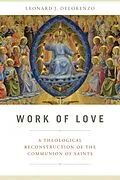
The saints are good company. They are the heroes of the faith who blazed new and creative paths to holiness; they are the witnesses whose testimonies echo throughout the ages in the memory of the Church. Most Christians, and particularly Catholics, are likely to have their own favorite saints, those who inspire and "speak" to believers as they pray and struggle through the challenges of their own lives. Leonard DeLorenzo's book addresses the idea of the communion of saints, rather than individual saints, with the conviction that what makes the saints holy and what forms them into a communion is one and the same. Work of Love investigates the issue of communication within the communio sanctorum and the fullness of Christian hope in the face of the meaning-or meaninglessness-of death. In an effort to revitalize a theological topic that for much of Catholic history has been an indelible part of the Catholic imaginary, DeLorenzo invokes the ideas of not only many theological figures (Rahner, Ratzinger, Balthasar, and de Lubac, among others) but also historians, philosophers (notably Heidegger and Nietzsche), and literary figures (Rilke and Dante) to create a rich tableau. By working across several disciplines, DeLorenzo argues for a vigorous renewal in the Christian imagination of the theological concept of the communion of saints. He concludes that the embodied witness of the saints themselves, as well as the liturgical and devotional movements of the Church at prayer, testifies to the central importance of the communion of saints as the eschatological hope and fulfillment of the promises of Christ.
Autorentext
Leonard J. DeLorenzo is associate professional specialist and Director of Notre Dame Vision in the McGrath Institute for Church Life, and he also teaches in the department of theology at the University of Notre Dame.
Inhalt
Acknowledgments
Introduction
CHAPTER 1
- Indefinite Article
- Looking Backward
- The Development of a Doctrine
- The Orthodoxy of the Body of the Faithful
- State of the Communion
- The Diagnosis
- Looking Forward
CHAPTER 2
- Solitary Confinement
- Regarding Christian Hope
- Forgetting Death
- Interlude: Transgressing the Forbidden, Seeing the Invisible
- The Rilkean Opening
- The View from Heidegger
- Remembering the Forgotten Death
CHAPTER 3
- Word of Life
- Toward a Christian Account of Death and Communication
- Karl Rahner: A Theology of Death within Christian Eschatology
- Joseph Ratzinger: Communication within Salvation History
- Hans Urs von Balthasar: Heeding Absolute Communication
- Given to Nothing: Creation and Resurrection
- The Word of Life
CHAPTER 4
- Dispossessing Desire
- Becoming Fully Human
- Encountering the Risen Christ: The Beginning of a New End
- At the End of All Exploring: What Augustine Found
- Ontology by Desire
- Desiring God
CHAPTER 5
- Bodily Memory
- A Fool's Errand?
- Ordering the Commedia
- The Communicative Nature
- The Space of Freedom
- The Church's Oblation
- Ascension, Assumption, and the Resurrection of the Body
CHAPTER 6
- Work of Love
- Hastening to Wholeness
- The Coming of the Lord
- A Beautiful Pattern: The Aesthetic Pedagogy of the Book of Exodus
- Interlude: Glory as Dwelling, Dwelling as Communion
- Thérèse of Lisieux and the Beauty of the Earth
- Teresa of Avila and the Beauty of Carmel
- Mother Teresa and the Beauty of Calcutta
- Dorothy Day and the Beauty of New York
- The Intermediate State and the Beauty of Wholeness
- Liturgical Training and the Beauty of Prayer
- God's People and the Beauty of Particularity
Conclusion
Notes
Selected Bibliography
Index