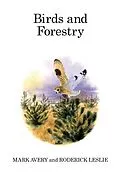
In this book, an ornithologist and a forester have combined their skills to try and tease out the real facts behind the various arguments on forestry.
The conflict between forestry and nature conservation has become a major environmental issue in Britain in the 1980s. The planting of large tracts of land with exotic conifers and the resulting disturbance of existing plant and animal communities has polarized the debate, each camp believing that it has the most rational view.
But the interactions involved are complex. Which bird species are really threatened? How can we judge the relative value of bird species ousted by plantations and the new species which colonize them? How can the need for forest products be reconciled with the demands of conservationists?
This fascinating book tackles these issues in a forthright manner. It represents a significant step towards achieving the sort of prudent land planning that will really improve our beleaguered countryside.
Jacket painting by Philip Snow. Foreword by David Bellamy.
Autorentext
Mark Avery has combined bird watching with a career as a biologist. Since graduating from Cambridge University he has studied at Oxford and Aberdeen Universities and worked on Great Tit song, food-hoarding by Marsh Tits, foraging and social behaviour of Bee-eaters and hibernation of pipistrelle bats. Mark joined the RSPB staff in 1986 to work in the Flow Country and is now a Senior Research Biologist for the Society working on scientific aspects of land-use, international and marine issues.
Roderick Leslie was educated at Rugby and Oxford, where he took a degree in Agriculture and Forest Sciences. Interested in waders, cannon-netting on the Wash and ringing, he joined the Forestry Commission in 1976 and became involved in studies of the birds of second rotation forest, including Nightjar. He has worked in Northumberland, North Yorkshire where he was BTO regional representative, and Thetford. In 1988, following a three-year term as the Forestry Commission's Wildlife and Conservation officer at F.C. Headquarters in Edinburgh, he became the Private Forestry & Environment Officer for the Commission's West of England Conservancy based in Bristol. He was a member of the RSPB Council from 1984-1989.
Inhalt
Foreword by David Bellamy
Preface
Acknowledgements
Chapter 1 Introduction
Chapter 2 Birds in Forests
Chapter 3 Managing the Forest
Chapter 4 Conservation Management
Chapter 5 The Birds of the Uplands
Chapter 6 The Effects of Afforestation on Upland Birds
Chapter 7 Case Studies
Chapter 8 Money and Power in the Uplands
Chapter 9 The Future
References
Appendix: Scientific names of birds, plants and fungi, mammals and invertebrates mentioned in the text
Index