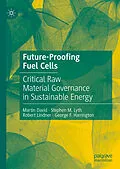
As the world accelerates towards a renewable energy transition, the demand for critical raw materials (CRMs) for energy generation, conversion, and storage technologies is seeing a drastic increase. Such materials are not only subject to limited supply and extreme price volatility but can also represent serious burdens to the environment, to human health, and also to socio-political systems. Taking an interdisciplinary perspective, this book provides a novel perspective on the discussion about material dependencies of energy technologies. It examines CRMs use in fuel cells, an emerging energy conversion technology, and discusses governance strategies for early-stage fuel cell development to predict and avoid potential issues. This will be an invaluable resource for researchers in energy studies, engineering, sociology and political science as well as those with a general interest in this field looking for an accessible overview.
Martin David is a Postdoctoral Researcher and Lecturer in the Institute of Sustainability Governance at Leuphana University in Germany. He conducts research in the field of Environmental Sociology, Science and Technology Studies, and Sustainability Transitions. Among other topics, Martin has a proven track of investigating processes of innovation and sociotechnical discontinuation in energy transitions.
Stephen M. Lyth is an Associate Professor at Kyushu University in Japan and has authored over 75 papers on energy and materials. He was a recipient of the prestigious "NICE STEP Researcher Award 2019" from the Japanese Ministry of Education, Culture, Sports, Science and Technology (MEXT) for significant contribution to science and technology. Robert Lindner is an Associate Professor at Kyushu University's Faculty of Law and the Platform for Inter/Transdisciplinary Energy Research (Q-PIT). He is a political scientist with an interest in energy and environmental governance, international relations, and sustainability transitions in developing countries.
George F. Harrington is an Assistant Professor at Kyushu University in Japan, working in the Next-Generation Fuel Cell Research Centre (NEXT-FC) and Center for Co-Evolutional Social Systems (CESS), and also holds a Visiting Scholar position at the Massachusetts Institute of Technology in the Department of Materials Science and Engineering. His research is focused on advanced functional oxide materials for applications in energy conversion and information storage.
Autorentext
Martin David is a Postdoctoral Researcher and Lecturer in the Institute of Sustainability Governance at Leuphana University in Germany. He conducts research in the field of Environmental Sociology, Science and Technology Studies, and Sustainability Transitions. Among other topics, Martin has a proven track of investigating processes of innovation and sociotechnical discontinuation in energy transitions.
Stephen M. Lyth is an Associate Professor at Kyushu University in Japan and has authored over 75 papers on energy and materials. He was a recipient of the prestigious NICE STEP Researcher Award 2019 from the Japanese Ministry of Education, Culture, Sports, Science and Technology (MEXT) for significant contribution to science and technology.
Robert Lindner is an Associate Professor at Kyushu University's Faculty of Law and the Platform for Inter/Transdisciplinary Energy Research (Q-PIT). He is a political scientist with an interest in energy and environmental governance, international relations, and sustainability transitions in developing countries.
George F. Harrington is an Assistant Professor at Kyushu University in Japan, working in the Next-Generation Fuel Cell Research Centre (NEXT-FC) and Center for Co-Evolutional Social Systems (CESS), and also holds a Visiting Scholar position at the Massachusetts Institute of Technology in the Department of Materials Science and Engineering. His research is focused on advanced functional oxide materials for applications in energy conversion and information storage.
Inhalt