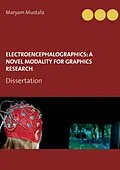
My work uses EEG data to determine the perceptual quality of videos and images which is of paramount importance for most graphics algorithms. This is especially important given the gap between perceived quality of an image and physical accuracy. This thesis begins by introducing the fundamentals of EEG measurements and its neurophysiological basis. Following this introduction, I present a novel method for determining perceived image and video quality from a single trial of EEG data in response to typical rendering artifacts. I also explore the use of EEG for direct neural feedback and present a neural-feedback loop for the optimization of rendering parameters for images and videos. I conclude with an outlook on what the future of EEG in graphics may hold.
Autorentext
Maryam Mustafa:Maryam Mustafa is a researcher at the Computer Graphics Lab of Technische Universität Braunschweig's Computer Science Department. Her researchinterests include humancomputer interaction, perceptual graphics, and computer graphics and cognition. Mustafa received an MEng in computer science from Cornell University, and a PhD from the Technische Universität Braunschweig.
Autorentext
Maryam Mustafa:Maryam Mustafa is a researcher at the Computer Graphics Lab of Technische Universität Braunschweig's Computer Science Department. Her researchinterests include humancomputer interaction, perceptual graphics, and computer graphics and cognition. Mustafa received an MEng in computer science from Cornell University, and a PhD from the Technische Universität Braunschweig.
Titel
ElectroEncephaloGraphics: A Novel Modality For Graphics Research
Untertitel
Dissertation
Autor
EAN
9783739296661
ISBN
978-3-7392-9666-1
Format
E-Book (epub)
Hersteller
Herausgeber
Genre
Veröffentlichung
01.10.2015
Digitaler Kopierschutz
Wasserzeichen
Dateigrösse
4.25 MB
Anzahl Seiten
144
Jahr
2015
Untertitel
Englisch
Auflage
1. Auflage.
Unerwartete Verzögerung
Ups, ein Fehler ist aufgetreten. Bitte versuchen Sie es später noch einmal.