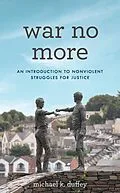
In the twentieth and early twenty-first centuries, nonviolent movements for justice have succeeded where violent campaigns have failed. This book examines fourteen cases-eleven movements that succeeded and three that have, until now, failed-and shows why nonviolent strategies work, drawing on the thought of practitioners and theorists. Later chapters examine violent U.S. interventions abroad and at home, as well as citizen movements for nonviolent conflict resolution.
As an introduction to nonviolent movements, this text engages students in recent events from the news as well as the history of modern warfare. Bringing in philosophical and religious texts from a diverse set of traditions, author Michael K. Duffey offers a multifaceted argument for embracing nonviolent solutions to conflict.
Autorentext
Michael K. Duffey is associate professor emeritus and former director of the Interdisciplinary Major in Peace Studies at Marquette University. Duffey specializes in theological ethics with particular attention to issues of justice and peace, human rights, and Protestant and Catholic ethical methodologies. His most recent books are Sowing Justice, Reaping Peace: Case Studies of Racial, Religious, and Ethnic Healing Around the World and Peacemaking and the Challenge of Violence in World Religions (coedited with Irfan A Omar).
Inhalt
Introduction
Chapter One A Hundred Years of Horrific War-making
The Just War Tradition
World Wars I and II
Five U.S. wars of choice
The war after the war
When wars are unjust
Chapter Two Mohandas Gandhi, the father of modern nonviolent, and war resistance
Early life and South Africa
Gandhi's principles
Gandhi's nonviolent campaigns in India
Nonviolent resistance to the Third Reich?
Nonviolent resistance in occupied Denmark
The rescue of Jews in Southern France
Chapter Three Successful Nonviolent Revolutions
People Power in the Philippines
Poland's and East Germany's victory against Communism
Serbia's Otpor
Tunisia and the beginning of the Arab Spring
Women's liberation in Liberia
Chapter Four Systemic Racism from the Civil Rights Struggle to the Black Lives Matter Movement
U.S. Civil Rights Movements in the 1960s.
The Student Nonviolent Coordinating Committee
Malcolm X and the Black Panther Party for Self-Defense
Black Lives Matter
Chapter Five Nonviolent Struggles U..S. Farm Laborers, Native Americans, and Black South Africans
La Causa: justice for migrant farm workers
Native Americans recovering the center
Ending Apartheid in South Africa
Chapter Six Violent America
Empire
Building, buying, and selling weapons
Wars on the home front
Citizen activism?
Chapter Seven Citizen Movements against Violence
Building blocks
Challenging U.S. violence abroad
Overcoming violence at home: systemic racism, poverty, and incarceration
Gun violence
Defending the environment
Chapter Eight Nonviolence, world religions, and the virtues
Hinduism, Buddhism, Sikhism, Judaism, Christianity, Islam, and Indigenous Spiritualities
Empathy
Negative and positive otherness
Justice and mercy
Forgiveness and repentance
Afterword
Reaffirming the Power of Nonviolence
Ireland's violent journey to peace
How risky is nonviolence?
Appendix One Two Unsuccessful Nonviolent Struggles for Justice:
Egypt's Arab Spring and the Israel-Palestine conflict
Appendix Two A Thought Experiment: Could emancipation have been achieved without the Civil War?
Abolition, Congressional accommodation, and the Civil War
Bibliography
Index