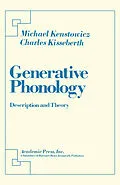
Generative Phonology: Description and Theory provides a basic understanding of the fundamental concepts of generative phonology and the applications of these concepts in further study of phonological structure. This book is composed of 10 chapters and begins with a survey of phonology in the overall model of generative grammar and introduces the principles of phonetics to. The subsequent chapters introduce the fundamental concept of a phonological rule that relates an underlying representation to a phonetic representation and this concept is applied to the analysis of morphophonemic alternation. These topics are followed by a presentation of phonological sketches of four diverse languages in terms of rules relating underlying and phonetic representations, as well as the major corpus-internal principles and techniques of phonological analysis. The discussion then shifts to the theoretical aspects of phonology, the various degrees of abstractness, and the proposals to limit the divergence between underlying and phonetic representation. Other chapters deal with some of the issues revolving around the representation of sounds and the various hypotheses as to how phonological rules apply to convert the underlying representation to the phonetic representation, particularly the kinds of considerations that motivate rule-ordering statements. The last chapters explore the major notational devices commonly employed in the formulation of phonological rules and the role of syntactic and lexical information in controlling the application of phonological rules. This book is intended primarily for linguistics and phonologists.
Inhalt
Preface
1 Preliminaries
The Setting of Phonology within Generative Grammar
Linguistic Phonetics: A Brief Survey
2 Phonological Rules and Representations
The Null Hypothesis
Zoque
Papago
Chatino
Exercises
3 Alternation
Russian
Chamorro
Tonkawa
Exercises
4 Phonological Sketches
The Yawelmani Dialect of Yokuts
Slovak
Lardil
Makua (Bantu)
Exercises
5 Evidence and Motivation
Corpus-Internal Evidence
Corpus-External Evidence
Exercises
6 The Problem of Abstractness
The Morpheme Alternant Theory
The Basic Alternant
Abstract Segments
The Alternation Condition
The True Generalization Condition
Exercises
7 The Representation of Sounds
The Feature Notation
A Survey of the Features
The Syllable
The Representation of Tone
Exercises
8 Rule Interaction
The Direct Mapping Hypothesis
The Free Reapplication Hypothesis
The Ordered-Rule Hypothesis
The Multiple Application Problem
Exercises
9 Notation
Convention on Rule Application
Abbreviatory Devices-An Overview
The Parenthesis Notation
Angled Brackets
The Brace Notation
Variable Feature Values
Mirror-Image Rules
Transformational Rules in Phonology
The Representation of Length
Sources of Evidence for the Underlying Unity of Phonological Processes
Exercises
10 The Role of Syntax and the Lexicon in Phonology
Extragrammatical Information
Lexical Information
Grammatical Categories and Features
Boundaries
Cyclic Rules
Morpheme Structure Constraints
Exercises
References
Language Index
Subject Index