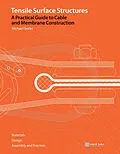
Textile Hüllen sind Ausdruck einer intensiven Auseinandersetzung von Planern mit dem Thema Haut in der Architektur. Fortschritte in der Entwurfsmethodik, Werkstofftechnik, Bauteilentwicklung und Montageplanung im Technologiefeld Hoch-Leichtbau ermöglichen zunehmend anspruchsvollere Anwendungen von Textilen Hüllen mit raumbildender und tragender Funktion, insbesondere bei der Überdachung großer, stützenfreier Räume.
Die Besonderheiten des mechanischen Verhaltens der beim Bau von Textilen Hüllen verwendeten Werkstoffe werfen allerdings zwingend die Frage nach der "Baubarkeit" auf. Im vorliegenden Buch wird daher der grundsätzliche Einfluss von Fragen der Materialherstellung und Montage auf die Festlegung des bestgeeigneten Bau- oder Tragwerkstypus und dessen Detaillierung im Entwurfs- und Planungsprozess besprochen.
Die Grundlagen über den stofflichen Aufbau, den Fertigungsprozess, die Zuschnittsermittlung und das Materialverhalten von biegeweichen Tragelementen werden ebenso erläutert wie deren Funktion als Trag- und Verbindungselement. Ausführlich behandelt wird die Montage von Weitgespannten Flächentragwerken. Dazu werden die Montagemittel, die Hebe- und Spannprozesse und die Montageverfahren zur Errichtung charakteristischer Strukturformen beschrieben und anhand ausgewählter Projekte dokumentiert.
Mit einem Geleitwort von Werner Sobek.
Autorentext
DI Dr. techn. Michael Seidel is lecturing in membrane structures at the Institute of Architecture and Design of the Technical University Vienna. As consultant engineer he has a wide range of experiences in planning and realising membrane and cable structures.
Zusammenfassung
Tensile surface structures are the visual expression of an intensive rethinking of the topic of building envelopes by designers. Advances in design methods, materials, construction elements and assembly and erection planning in the field of lightweight construction are enabling ever more exacting applications of tensile structures with envelope and structural functions, especially in roofing over large clear spans without internal support.
However, the particular mechanical characteristics of the materials used in the construction of textile structures demand consideration of the question of "buildability". This book provides answers by discussing the fundamental influence of material manufacture and assembly in deciding the most suitable type of building or structure and its detailing in the design process.
The fundamentals of material composition, manufacturing process, patterning and the behaviour of flexible structural systems are all explained here, as well as their use as structural and connection elements, and special attention is given to the erection of wide-span lightweight structures. The erection equipment is described, as well as the lifting and tensioning process and the construction methods used to erect the characteristic types of tensile structures, illustrated with a selection of example projects.
Forword by Werner Sobek.
Inhalt
EINLEITUNG
MATERIALIEN BIEGEWEICHER TRAGELEMENTE
Struktureller Aufbau
Materialverhalten beschichteter Gewebe
Konfektion beschichteter Gewebe
Arten der Fügung in der Fläche
Arten der Krafteinleitung am Rand
Eckausbildungen
MONTAGE BIEGEWEICHER TRAGELEMENTE
Montageplanung
Montagemittel
Montageverfahren
Montagedurchführung
Kontrolle
PROJEKTE
LITERATUR
STICHWORTVERZEICHNIS