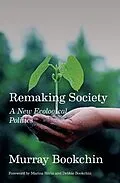
Moving toward an ecological utopia.
According to Murray Bookchin, a humane solution to the climate crisis?a crisis he was among the first to identify?will require replacing industrial capitalism with an egalitarian, ecological society, decentralized democratic communities, and sustainable technologies like solar power, organic agriculture, and humanly scaled industries. Since he first penned these ideas, our situation has only gotten worse, and people want answers. Drawing on rich traditions of ecological science, anthropology, history, utopian philosophy, and ethics, Remaking Society offers today's environmentalists a coherent framework for social and ecological reconstruction. This pioneering work on nature and society provides readers with clear strategies for averting disaster.
Autorentext
Murray Bookchin (1921-2006) was an active voice in the ecology, anarchist, and communalist movements for more than fifty years. His groundbreaking essay, "Ecology and Revolutionary Thought” (1964), was one of the first to assert that capitalism's grow-or-die ethos was on a dangerous collision course with the natural world that would include the devastation of the planet by global warming. Bookchin is the author of The Ecology of Freedom, among two dozen other books. He was born in New York, NY.
Klappentext
Moving toward an ecological utopia.
According to Murray Bookchin, a humane solution to the climate crisis—a crisis he was among the first to identify—will require replacing industrial capitalism with an egalitarian, ecological society, decentralized democratic communities, and sustainable technologies like solar power, organic agriculture, and humanly scaled industries. Since he first penned these ideas, our situation has only gotten worse, and people want answers. Drawing on rich traditions of ecological science, anthropology, history, utopian philosophy, and ethics, Remaking Society offers today's environmentalists a coherent framework for social and ecological reconstruction. This pioneering work on nature and society provides readers with clear strategies for averting disaster.
Inhalt
Foreword
IntroductionWhy This Book Was Written
Society and Ecology
Hierarchies, Classes, and States
Turning Points in History
Ideals of Freedom
Defining the Revolutionary Project
From Here to There
Notes
Index