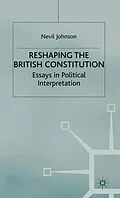
Reshaping the British Constitution provides a vigorous critique of the deformations of Britain's customary constitution and why it could not effectively stem the growth of a centralized political authority. On this foundation it provides a critical description and assessment of recent constitutional changes including devolution, House of Lords reform, human rights and the encroachment of the European Union. Nevil Johnson suggests that since the reform programme has rested on pragmatic political expediency rather than on coherent thinking about constitutional principles, it is likely to strengthen the familiar deformations of the customary constitution.
Autorentext
NEVIL JOHNSON is an Emeritus Fellow of Nuffield College, Oxford, where from 1969 to 1996 he was a Reader in the Comparative Study of Institutions in the University of Oxford and Professorial Fellow. The early years of his career were spent in the administrative class of the Civil Service. From 1966 to 1981 he edited the journal Public Administration, from 1981 to 1987 he was a member of the Economic and Social Research Council and he served as a part-time Civil Service Commissioner from 1982 to 1985. He has twice held visiting professorships in Germany and has many publications to his credit, including In Search of the Constitution: Reflections on State and Society in Britain (1977) and State and Government in the Federal Republic of Germany (1982).
Zusammenfassung
The British constitution is an elusive business, usually dissolving into mere politics when people try to come to grips with it. Reshaping the British Constitution is a critical, sceptical study that seeks to address the issue by first discussing what is involved in having a constitution and, in particular, a customary uncodified constitution like that of Britain. After recalling the almost forgotten tradition of dispersal of powers and checks and balances, Nevil Johnson then turns to the contemporary working of the British constitution, surveying the Monarchy and religious establishment, the central Government and its powers, Parliament and the position of the Judiciary. All this provides a basis for a detailed examination of the principal post-1997 reforms - devolution, the Human Rights Act 1998 and its effects, the failure of House of Lords reform, and the impact of EU membership on the constitution. Johnson concludes that Britain is as far as it ever was from real 'checks and balances' and that the 'elective dictatorship' is even stronger.
Inhalt
Preface Introduction PART I: THE UNDERPINNINGS OF THE CUSTOMARY CONSTITUTION Constitutions and Constitutionalism Foundations and Principles Institutional Pluralism and Subsidiarity PART II: INSTITUTIONS AND PRACTICES UNDER THE CUSTOMARY CONSTITUTION Symbols of Unity: Monarchy and Religious Establishment A Parliamentary Government: the Executive Power The Foundations of Legitimacy: Parliament The Judiciary in the Constitution PART III: RESHAPING THE CONSTITUTION The Customary Constitution in the Melting-pot Institutional Innovation: Devolution and Decentralisation Reform at the Centre: the Primacy of Politics Human Rights and Reinforcement of the Judiciary Constitutional Consequences of Membership of the European Union Beyond Custom and Tradition: the Politics of Pragmatic Adaptation