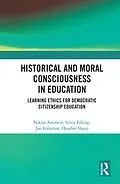
Historical and Moral Consciousness highlights how ethics can be understood in the context of History education. It analyses the qualitative differences in how young people respond to historical and moral dilemmas of relevance to democratic values and human rights education.
Drawing on a four-year international project, the book offers nuanced discussion and new scholarly understanding of the intersections between historical consciousness and moral consciousness within research. It develops new theoretical tools for history teaching and learning that can support teachers as they endeavor to educate for democratic citizenship. The book includes a meta-analysis of research within history Didaktik and around historical events with a moral bearing, and presents a comparative study of Australian, Finnish, and Swedish high school students' moral understandings of historical dilemmas.
Raising important questions about how our learning from the past is intertwined with our present and future interpretations and judgements, this book will be of great interest to academics, scholars, teachers, and post graduate students in the fields of history education, democratic education, human rights education, and citizenship education.
Autorentext
Niklas Ammert is Professor in History at Linnaeus University, Sweden.
Silvia Edling is Professor in Curriculum Studies at the University of Gävle, Sweden.
Jan Löfström is Associate Professor in History and Social Studies Education at the University of Turku, Finland and Visiting Professor of History Education at Linnaeus University, Sweden.
Heather Sharp is Associate Professor in Education at the University of Newcastle, Australia.
Inhalt
List of Tables
Acknowledgements
Chapter 1: Introduction
PART I: Reflections in research
Chapter 2: Historical consciousness and the human condition - revisiting moral motivations and their implications for education
Chapter 3: Language as a means to broaden horizons of perception: third order concepts in research about Historical Consciousness
Chapter 4: Systematic review of historical consciousness and moral consciousness (mapping the material but understanding the field theoretically)
Chapter 5: Discourses of historical consciousness and moral consciousness in Australian doctoral theses
Chapter 6: Why is ethics important in history education? A dialogue between the various ways of understanding the relationship between ethics and historical consciousness
PART II: Young people's perceptions / Concepts applied
Chapter 7: In search for intersections of historical and moral consciousness in students' answers: how a research instrument was designed and used
Chapter 8: Temporal orientation and moral reflections
Chapter 9: Exploring moral sensitivity and historical empathy in students' response to a historical moral dilemma
Chapter 10: History interactions: Students pose questions to a difficult past
Chapter 11: Students on moral judgment making in History and the place of moral questions in the History Classroom
PART III: Conclusions and implications for teaching
Chapter 12: Conclusions - a new theoretical framework