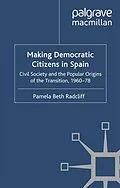
A fascinating study of the contribution of ordinary men and women to Spain's democratic transition of the 1970s. Radcliff argues that participants in neighbourhood and other associations experimented with new practices of civic participation that put pressure on the authoritarian state and made the building blocks of a future democratic citizenship
Autorentext
PAMELA RADCLIFF Associate Professor of History at the University of California, San Diego, USA. She has published various works on modern Spain, including From Mobilization to Civil War: The Politics of Polarization in the Spanish City of Gijon, 1900-1937, and Contesting Spanish Womanhood, a collection of scholarly essays co-edited with Victoria Enders.
Inhalt
List of Abbreviations and Foreign Terms Introduction Dictatorship and Civil Society: Explaining the Roots of a New Associational Milieu Measuring' Civil Society: The Scope and Vitality of the New Associational Milieu Gender and the Role of Women in the Associational Milieu What is a Family Association?:The Civic Discourse of Familiarismo Women and Familiarismo: The Civic Discourse of the Homemaker Associations The Civic Discourse of the Neighborhood Associations of Madrid: From Community Improvement to 'Citizen Movement' The Civic Community in Practice: Family and Neighborhood Associations as 'Schools of Democracy' Conclusion/Epilogue Bibliography Index
Titel
Making Democratic Citizens in Spain
Untertitel
Civil Society and the Popular Origins of the Transition, 1960-78
Autor
EAN
9780230302136
ISBN
978-0-230-30213-6
Format
E-Book (pdf)
Hersteller
Herausgeber
Veröffentlichung
23.03.2011
Digitaler Kopierschutz
Wasserzeichen
Dateigrösse
1.72 MB
Anzahl Seiten
416
Jahr
2011
Untertitel
Englisch
Unerwartete Verzögerung
Ups, ein Fehler ist aufgetreten. Bitte versuchen Sie es später noch einmal.