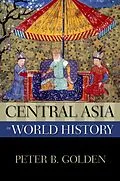
A vast region stretching roughly from the Volga River to Manchuria and the northern Chinese borderlands, Central Asia has been called the "pivot of history," a land where nomadic invaders and Silk Road traders changed the destinies of states that ringed its borders, including pre-modern Europe, the Middle East, and China. In Central Asia in World History, Peter B. Golden provides an engaging account of this important region, ranging from prehistory to the present, focusing largely on the unique melting pot of cultures that this region has produced over millennia. Golden describes the traders who braved the heat and cold along caravan routes to link East Asia and Europe; the Mongol Empire of Chinggis Khan and his successors, the largest contiguous land empire in history; the invention of gunpowder, which allowed the great sedentary empires to overcome the horse-based nomads; the power struggles of Russia and China, and later Russia and Britain, for control of the area. Finally, he discusses the region today, a key area that neighbors such geopolitical hot spots as Iran, Afghanistan, Pakistan, and China.
Autorentext
Peter B. Golden is Professor Emeritus of History and Director of the Middle Eastern Studies Program, Rutgers University.
Inhalt
Editors' Preface Introduction: A Layering of Peoples Chapter 1: The Rise of Nomadism and the Oasis City-States Chapter 2: The Early Nomads: "Warfare is Their Business" Chapter 3: Heavenly Qaghans: The Türks and Their Successors Chapter 4: The Cities of the Silk Road and the Coming of Islam. Chapter 5: Crescent over the Steppe: Islam and the Turkic Peoples Chapter 6: The Mongol Whirlwind Chapter 7: The Later Chinggisids, Temür and the Timurid Renaissance Chapter 8: The Age of Gunpowder and the Crush of Empires Chapter 9: The Problems of Modernity Pronunciation Guide Chronology Notes Further Reading Websites Acknowledgments Index