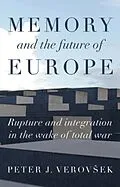
Memory and the future of Europe examines the role of collective memory in the origins and development of the European Union. It traces Europe's political, economic and financial crisis to the loss of the remembrance of the rupture of 1945. As the generations with personal memories of the two world wars pass away, economic welfare has become the EU's sole raison d'être. If it is to survive its future challenges, the EU will have to create a new historical imaginary that relies not only on the lessons of the past but also builds on Europe's ability to protect its citizens against the power of global market forces. Framing its argument through the critical theory of the Frankfurt School, this volume will attract readers interested in political and social philosophy, collective memory studies, European studies, international relations and contemporary politics.
Autorentext
Peter J. Verovek is Lecturer (Assistant Professor) in Politics and International Relations at the University of Sheffield
Klappentext
The establishment of the European Union was the most significant development in twentieth-century political organisation. Despite the EU's achievements, events at the beginning of the twenty-first century pose an existential threat. Memory and the future of Europe treats integration as a response to the rupture created by the age of total war. As the generations with personal memories of the two world wars have passed away, economic gain has increasingly become the EU's sole raison d'être. If the Union is to survive, it will have to create a new historical imaginary that builds on the experiences of those who have grown up in a unified Europe and on the EU's ability to protect its citizens from the forces of globalisation.
Zusammenfassung
This book examines the role of collective memory in the origins and development of the European Union. It traces Europe's political, economic and financial crisis to the loss of these memories of the rupture of 1945. In order to survive the EU will have to prove that it can act effectively in the face of future challenges.
Inhalt
Introduction1 Collective memory as a resource for political changePart I Origins and crisis diagnosis2 Choosing integration based on the community model: memory, leadership, and the first phase of integration (194558)3 Counter-memory and generational change: Eurosclerosis (195984) and the second phase of integration (19852003)4 The fragmentation and loss of European memory: the Eurozone crisis, Brexit, and possible disintegrationPart II Memory and the future of Europe5 Changing generations, negative memory, and non-economic resources6 The future of Europe from a comparative perspectiveConcluding remarks: a plea for politics at the European levelSelect bibliographyIndex