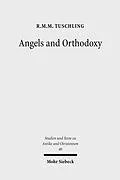
Ruth Tuschling considers the relation between ideas about angels, especially their function within a monotheistic belief system, and the development of a sense of what it means to be orthodox, in both Judaism and Christianity, from the time of the Dead Sea Scrolls to the late fourth century AD, geographically limited to Syria and Palestine. The first chapter contains an historical overview of angelological concepts in Judaism, before the exile in Babylon, after the exile, and after the rise of Christianity. Here the author also gives an analysis of key vocabulary and modern categories of angels, e.g. archangel, principal angel, hypostasis. She exemplifies her findings in three case studies in chapter two: Qumran, especially the Songs of the Sabbath Sacrifice, Origen, Ephrem the Syrian. The liturgical chapter three considers the Qedushah and sanctus, noting the Jewish origin of the 'heaven and earth are full...' expansion. Both are characterized as a liturgical call and response, in a two-part structure; the extant forms survive out of a great variety, both Jewish and Christian. The idea of sacred time and sacred space are linked with the parallel worship of earth and heaven; priests and angels are seen as comparable sacred persons in their liturgical function. In conclusion, angels' theological function is seen to support orthodoxy by modelling the right practice, and hence belief, towards God.
Born 1965; studied classics at Freiburg im Breisgau; ordination training for the Anglican priesthood at Westcott House, Cambridge, including study for Cambridge BA curate in London; 2004 PhD (Cambridge); novice of Burford Priory (Anglican Benedictine religious community).
Autorentext
Zusammenfassung
Ruth Tuschling untersucht die Funktion der Engel im Monotheismus. Sie geht den Fragen nach, woher Engelvorstellungen im Judentum und Christentum stammen und welche Formen der Engelverehrung existierten. Dazu analysiert sie Engelvorstellungen aus der Zeit vor und nach dem babylonischen Exil, im 1. Jh. sowie nach 70 n. Chr. Inwieweit die Engelvorstellungen im Christentum den Monotheismus bedrohen oder sogar eher unterstützen, ist ebenso Thema der Untersuchung wie die Textanalyse des Sanctus der Liturgie und eine genaue Analyse der unterschiedlichen (auch modernen) Kategorien von Engeln. Abschließend zeigt sich, daß Engel als Modelle dienen, denen die Gläubigen nachahmen sollen, und daß sie somit die Orthodoxie bestärken.
Born 1965; studied classics at Freiburg im Breisgau; ordination training for the Anglican priesthood at Westcott House, Cambridge, including study for Cambridge BA curate in London; 2004 PhD (Cambridge); novice of Burford Priory (Anglican Benedictine religious community).
Autorentext
Born 1965; studied classics at Freiburg im Breisgau; ordination training for the Anglican priesthood at Westcott House, Cambridge, including study for Cambridge BA curate in London; 2004 PhD (Cambridge); novice of Burford Priory (Anglican Benedictine religious community).
Zusammenfassung
Ruth Tuschling untersucht die Funktion der Engel im Monotheismus. Sie geht den Fragen nach, woher Engelvorstellungen im Judentum und Christentum stammen und welche Formen der Engelverehrung existierten. Dazu analysiert sie Engelvorstellungen aus der Zeit vor und nach dem babylonischen Exil, im 1. Jh. sowie nach 70 n. Chr. Inwieweit die Engelvorstellungen im Christentum den Monotheismus bedrohen oder sogar eher unterstützen, ist ebenso Thema der Untersuchung wie die Textanalyse des Sanctus der Liturgie und eine genaue Analyse der unterschiedlichen (auch modernen) Kategorien von Engeln. Abschließend zeigt sich, daß Engel als Modelle dienen, denen die Gläubigen nachahmen sollen, und daß sie somit die Orthodoxie bestärken.
Titel
Angels and Orthodoxy
Untertitel
A Study in their Development in Syria and Palestine from the Qumran Texts to Ephrem the Syrian
Autor
EAN
9783161513398
ISBN
978-3-16-151339-8
Format
E-Book (pdf)
Hersteller
Herausgeber
Digitaler Kopierschutz
Adobe-DRM
Dateigrösse
4.69 MB
Anzahl Seiten
282
Jahr
2007
Untertitel
Englisch
Unerwartete Verzögerung
Ups, ein Fehler ist aufgetreten. Bitte versuchen Sie es später noch einmal.