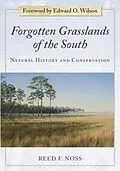
Forgotten Grasslands of the South is the study of one of the biologically richest and most endangered ecosystems in North America. In a seamless blend of science and personal observation, renowned ecologist Reed Noss explains the natural history of southern grasslands, their origin and history, and the physical determinants of grassland distribution, including ecology, soils, landform, and hydrology.
In addition to offering fascinating new information about these little-studied ecosystems, Noss demonstrates how natural history is central to the practice of conservation. Although theory and experimentation have recently dominated the field of ecology, ecologists are coming to realize how these distinct approaches are not divergent but complementary, and that pursuing them together can bring greater knowledge and understanding of how the natural world works and how we can best conserve it.
This long-awaited work sets a new standard for scientific literature and is essential reading for those who study and work to conserve the grasslands of the South as well as for everyone who is fascinated by the natural world.
Autorentext
Reed Noss is Provost's Distinguished Research Professor at the University of Central Florida and President of the Florida Institute for Conservation Science. He has a B.S. in Education from the University of Dayton, an M.S. in Ecology from the University of Tennessee, and a Ph.D. in Wildlife Ecology from the University of Florida. He has served as Editor-in-Chief of Conservation Biology (1993-1997), President of the Society for Conservation Biology (1999-2001), and President of the North American Section of the Society (2006-2008). He is an elected Fellow of the American Association for the Advancement of Science and has served on many boards and advisory panels, including the Board of Governors of the Society for Conservation Biology, the Board of Trustees of the Florida Chapter of The Nature Conservancy, and Florida's Acquisition and Restoration Council. He recently served as Vice-Chair of a Federal Advisory Committee for the U.S. Climate Change Science Program.
Professor Noss has nearly 300 publications and is recognized as one of the 500 most highly cited authors in all fields. His research involves the application of science to species-level and ecosystem-level conservation planning, restoration, and management. He is currently writing a book on southern grasslands, studying the effects of suburban and exurban development on bird communities, and conducting research on impacts of, and adaptation to, sea-level rise in Florida.
Inhalt
Foreword; Edward O. Wilson
Preface
Acknowledgments
Chapter 1: Natural History of a Forgotten American Grassland
Natural History for Conservation
Grasslands in the South?
What and Where Are Southern Grasslands?
The Grasslands Considered in This Book
Joshua Creek
Chapter 2: Origin and History
A General Model
Geology, Physiography, and Pre-Neogene History
Neogene and Quaternary History
Disjunctions and the Gulf Coastal Corridor
Human History in the South, as It Relates to Grasslands
Mills Creek
Chapter 3: Biological Hotspots and Endangered Ecosystems
Discovering Lost Worlds
Endemism
Centers of Endemism in the South
Peripherals and Disjuncts
Species Richness
Species Richness in Southern Grasslands
People Care about Diversity, Endemism, and Disjunctions
The Decline of Southern Grasslands
Chapter 4: Physical Factors: Rock, Soil, Landform, Water, and Wind
The Purpose of My Journeys
Rock, Soil, and Landform
Water
Wind, Storms, and Sea-Level Rise
Chapter 5: Fire, Big Animals, and Interactions
Bottom-Up, Top-Down, and Sideways
Fire
Herbivores
Interaction of Fire and Hydrology
The Enigmatic Canebrakes
Chapter 6. The Future of Southern Grasslands: Outline of a Strategy
A Conservation Strategy for Southern Grasslands
Examples of Restoration Projects
The Future?
Species List
Literature Cited
About the Author
Index.