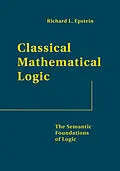
In Classical Mathematical Logic, Richard L. Epstein relates the systems of mathematical logic to their original motivations to formalize reasoning in mathematics. The book also shows how mathematical logic can be used to formalize particular systems of mathematics. It sets out the formalization not only of arithmetic, but also of group theory, field theory, and linear orderings. These lead to the formalization of the real numbers and Euclidean plane geometry. The scope and limitations of modern logic are made clear in these formalizations.
The book provides detailed explanations of all proofs and the insights behind the proofs, as well as detailed and nontrivial examples and problems. The book has more than 550 exercises. It can be used in advanced undergraduate or graduate courses and for self-study and reference.
Classical Mathematical Logic presents a unified treatment of material that until now has been available only by consulting many different books and research articles, written with various notation systems and axiomatizations.
Autorentext
Richard L. Epstein received his doctorate in mathematics from the University of California, Berkeley. He is the author of eleven books, including two others in the series The Semantic Foundations of Logic (Propositional Logics and Predicate Logic), Five Ways of Saying "Therefore," Critical Thinking, and, with Walter Carnielli, Computability. He is head of the Advanced Reasoning Forum in Socorro, New Mexico.
Zusammenfassung
Atmospheric chemistry is one of the fastest growing fields in the earth sciences. Until now, however, there has been no book designed to help students capture the essence of the subject in a brief course of study. Daniel Jacob, a leading researcher and teacher in the field, addresses that problem by presenting the first textbook on atmospheric chemistry for a one-semester course. Based on the approach he developed in his class at Harvard, Jacob introduces students in clear and concise chapters to the fundamentals as well as the latest ideas and findings in the field. Jacob's aim is to show students how to use basic principles of physics and chemistry to describe a complex system such as the atmosphere. He also seeks to give students an overview of the current state of research and the work that led to this point. Jacob begins with atmospheric structure, design of simple models, atmospheric transport, and the continuity equation, and continues with geochemical cycles, the greenhouse effect, aerosols, stratospheric ozone, the oxidizing power of the atmosphere, smog, and acid rain. Each chapter concludes with a problem set based on recent scientific literature. This is a novel approach to problem-set writing, and one that successfully introduces students to the prevailing issues. This is a major contribution to a growing area of study and will be welcomed enthusiastically by students and teachers alike.
Inhalt
- FrontMatter,
- Contents,
- Preface,
- Acknowledgments,
- Introduction,
- I. Classical Propositional Logic,
- II. Abstracting and Axiomatizing Classical Propositional Logic,
- III. The Language of Predicate Logic,
- IV. The Semantics of Classical Predicate Logic,
- V. Substitutions and Equivalences,
- VI. Equality,
- VII. Examples of Formalization,
- VIII. Functions,
- IX. The Abstraction of Models,
- X. Axiomatizing Classical Predicate Logic,
- XI. The Number of Objects in the Universe of a Model,
- XII. Formalizing Group Theory,
- XIII. Linear Orderings,
- XIV. Second-Order Classical Predicate Logic,
- XV. The Natural Numbers,
- XVI. The Integers and Rationals,
- XVII. The Real Numbers,
- XVIII. One-Dimensional Geometry,
- XIX. Two-Dimensional Euclidean Geometry,
- XX. Translations within Classical Predicate Logic,
- XXI. Classical Predicate Logic with Non-Referring Names,
- XXII. The Liar Paradox,
- XXIII. On Mathematical Logic and Mathematics,
- Appendix: The Completeness of Classical Predicate Logic Proved by Gödel's Method,
- Summary of Formal Systems,
- Bibliography,
- Index of Notation,
- Index,