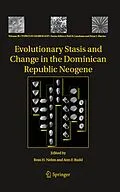
Here, a diverse group of geologists and paleobiologists focus their attention on the richly fossiliferous Neogene stratigraphic sections of the Dominican Republic. They provide an updated geological framework and a series of novel studies of evolutionary stasis and change among different lineages and associated ecological communities. This collection of studies illustrates the immense potential of collaborative, multidisciplinary, and field-based paleobiological research.
Zusammenfassung
Science is supposedly ultimately constrained by the nature of the physical world, meaning that changes in scientific methods and practice are supposed to be away from those with less utility and toward those that are more revealing, useful, and productive of insights into the nature of that world. In practice, however, science is no less susceptible to fads, culture shifts, and pendulum swings than any other realm of human endeavor. This is an especially important feature of science to keep in mind in the present climate of shrinking government funding (at least in prop- tion to the demand) and the resulting susceptibility of individual scientists and entire disciplines to being influenced by the changing priorities of funding agencies (even if, as such agencies maintain, those priorities come ultimately from the c- munity). The present volume is in several important respects a testimonial to both the threats and opportunities that such scientific culture swings pose, both for the individual researcher and a wider field. When scientific research in the Dominican Republic Neogene began more than a century ago, paleontology was an essentially descriptive discipline, focused mainly on finding, describing, and documenting the taxa represented in the fossil record, and (especially in invertebrate paleontology) on using these taxa for bi- tratigraphic correlation. Despite the successful integration of paleontology into the Modern Evolutionary Synthesis in the middle of the twentieth century (Simpson, 1944, 1953; Jepsen et al.
Inhalt
Palaeobiological Research in the Cibao Valley of the Northern Dominican Republic.- An Overview of the Regional Geology and Stratigraphy of the Neogene Deposits of the Cibao Valley, Dominican Republic.- Constraints on Late Miocene Shallow Marine Seasonality for the Central Caribbean Using Oxygen Isotope and Sr/Ca Ratios in a Fossil Coral.- Assessing the Effects of Taphonomic Processes on Palaeobiological Patterns using Turbinid Gastropod Shells and Opercula.- Early Evolution of the Montastraea annularis Species Complex (Anthozoa: Scleractinia): Evidence from the Mio-Pliocene of the Dominican Republic.- Evolutionary Patterns Within the Reef Coral Siderastrea in the Mio-Pliocene of the Dominican Republic.- Neogene Evolution of the Reef Coral Species Complex Montastraea cavernosa.- The Dynamics of Evolutionary Stasis and Change in the 'Prunum maoense Group'.- Assessing Community Change in Miocene to Pliocene Coral Assemblages of the Northern Dominican Republic.- Mollusc Assemblage Variability in the Río Gurabo Section (Dominican Republic Neogene): Implications for Species-Level Stasis.- The Impact of Fossils from the Northern Dominican Republic on Origination Estimates for Miocene and Pliocene Caribbean Reef Corals.- Science Education and the Dominican Republic Project.- The Neogene Marine Biota of Tropical America (NMITA) Database: Integrating Data from the Dominican Republic Project.
Titel
Evolutionary Stasis and Change in the Dominican Republic Neogene
Autor
Editor
EAN
9781402082153
ISBN
978-1-4020-8215-3
Format
E-Book (pdf)
Hersteller
Herausgeber
Veröffentlichung
21.03.2008
Digitaler Kopierschutz
Wasserzeichen
Dateigrösse
27.29 MB
Anzahl Seiten
316
Jahr
2008
Untertitel
Englisch
Unerwartete Verzögerung
Ups, ein Fehler ist aufgetreten. Bitte versuchen Sie es später noch einmal.