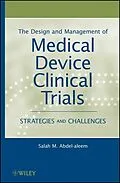
Clinical trials tasks and activities are widely diverse and require certain skill sets to both plan and execute. This book provides professionals in the field of clinical research with valuable information on the challenging issues of the design, execution, and management of clinical trials, and how to resolve these issues effectively. It discusses key obstacles such as challenges to patient recruitment, investigator and study site selection, and dealing with compliance issues. Through practical examples, professionals working with medical device clinical trials will discover the appropriate steps to take.
Autorentext
SALAH M. ABDEL-ALEEM, PhD, is Senior Manager of Clinical Operations at Proteus Biomedical, Inc., a medical device and pharmaceutical company that develops therapies for cardiovascular and diabetic diseases. He has over twenty years of experience in academic and corporate settings and has performed clinical research tasks and activities, such as the development of clinical standard operating procedures, clinical protocols, case report forms, clinical study forms, and investigator brochures for various academic and corporate settings. Dr. Abdel-aleem is the author of Design, Execution, and Management of Medical Device Clinical Trials, also published by Wiley.
Klappentext
An in-depth and insightful presentation on dealing effectively with the challenges of clinical trials
Clinical trials tasks and activities are widely diverse and require specific skill sets including excellent communication and management skills as well as the ability to develop different clinical scientific documents for successful planning and execution. The Design and Management of Medical Device Clinical Trials: Strategies and Challenges provides readers with valuable information on overcoming obstacles in these three vital stages of clinical trials. Focusing primarily on medical device clinical trials, the author discusses common challenges, such as investigator and study site selection, slow study enrollment, study endpoint determination, handling compliance issues, missing data analysis, and protocol deviations.
Rather than delve too far into statistical theory, the book outlines only the essential quantitative methods that need to be understood when working hands-on with clinical trial data and research. Through practical examples, common issues that arise in the development and implementation of clinical trials are discussed including:
-
The selection of historic controls over active control groups in clinical trials
-
Challenges to the regulations of medical devices, such as 510 K determination, determination of significant and non-significant risk devices, and similarities and differences of regulations between drugs and medical devices
-
Ways to identify and avoid fraud and misconduct in clinical trials
-
Obstacles encountered with the CE Mark process and global clinical trials
-
Challenges associated with high-profile FDA PMA cases where unconventional endpoints were used as the primary objectives of these studies
The Design and Management of Medical Device Clinical Trials: Strategies and Challenges is a valuable book for courses on biostatistics, epidemiology, and clinical research methods at the upper-undergraduate and graduate level. It is also an excellent reference for professionals in any area of clinical research who would like to learn more about working with medical device clinical trials and drug and biologics trials.
Inhalt
List of Abbreviations xi
Preface xiii
Acknowledgments xvii
1. Challenges to the Design of Clinical Study 1
Development of Clinical SOPs 3
Selection of Study Patients, Investigators, and Study Sites 3
Definition of Enrolled Subjects in a Clinical Study 7
Definition of the Investigational Device System 7
Research Contract Challenges 7
Review of Literature 9
Challenges to the Design of the Study Protocol, Statistical Analysis Plan (SAP), and Selection of Study Endpoints 11
Masking or Blinding 12
Primary and Secondary Outcomes 14
Selection of Study Endpoints 14
Differences between the Primary Endpoint in FDA and CE Mark Studies 15
SAP and Study Endpoints 15
Components of the SAP for Clinical Trials 17
Roles and Responsibilities of the Clinical Personnel in Completing the Study Protocol 19
Changing the Primary Outcome during the Conduct of the Study 20
Definition of Primary and Secondary Endpoints 22
Combined Composite Endpoints 22
Surrogate Endpoints 23
Reducing the Study's Sample Size 25
Statistical Terms to Define Endpoint Measurements 25
Reporting Results of Clinical Trials 28
Superiority and Equivalence Trials 30
Subgroup Analysis 33
Challenges to ICF 35
Risk/Benefit Analysis 41
2. Challenges to Managing the Study 43
Enhancing Patient Enrollment by Relaxation of Study Criteria 45
Compliance with the Study Protocol 46
Challenges Associated with Data Accuracy and Completeness 47
Data Analysis 49
Data Integrity 55
Criteria for Using Meta-Analysis Studies 56
Who Should have Access to Clinical Trial Records 57
Managing Study Data and Quality Assurance 58
Missing Data Analysis 59
Examination of Data across Study Sites 60
Challenges to Adverse Event Reporting 62
Adverse Event Coding Systems 66
Protocol Deviation Report 68
Adverse Event Reporting in Final Study Clinical Report 68
Difference between the US and EU Definitions and Reporting of Adverse Events 69
Adverse Event Reporting Challenges 69
Minimization of Bias in Clinical Trials 69
3. Selection of Historic Controls 71
Types of Control Group in Medical Device Clinical Trials 73
Purpose of Control Group 73
Use of Placebo Control 74
Advantages of Randomized Control Clinical Trials 74
Disadvantages of Randomized Control Clinical Trials 74
Commonly Used Pivotal Designs 75
Definition of Historic Control 77
Objective Performance Criteria (OPC) 78
Examples of Clinical Studies with Historic Controls 80
LACI Clinical Study 80
Left Ventricular Assist Devices 86
Summary of Clinical Studies 88
Summary of Recommendations for Historic Control 96
4. Fraud and Misconduct in Clinical Trials 99
Fraud and Misconduct in Clinical Trials 100
Warning Signs of Fraud 101
Tips for Detecting Serious Misconduct 102
False Claims Act 102
Fraud Prevention 103
Policy on Handling Complaints of Misconduct 103
Reporting Research Misconduct 104
Bioresearch Monitoring Information System (BMIS) 104
5. Challenges to the Regulation of Medical Device 107
Determination of 510(K) Devices 108
510(K) Substantial Equivalence Decision Making Process 111
Determination of Nonsignificant Risk Devices (NSR) 111
Similarities and Differences between Medical Device and Drug Regulations in Clinical Trials 112
Definitions of Drugs and Devices 113
Combination Products 126
FDASponsor Meetings 129
BIMO Inspection 130
Investigator-Initiated Clinical Trials 132
6. Challenges of Global Clinical Studies and the C...