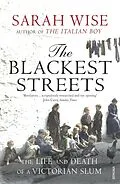
'An excellent and intelligent investigation of the realities of urban living that respond to no design or directive... This is a book about the nature of London itself' Peter Ackroyd, The Times
A powerful exploration of the seedy side of Victorian London by one of our most promising young historians.
In 1887 government inspectors were sent to investigate the Old Nichol, a notorious slum on the boundary of Bethnal Green parish, where almost 6,000 inhabitants were crammed into thirty or so streets of rotting dwellings and where the mortality rate ran at nearly twice that of the rest of Bethnal Green. Among much else they discovered that the decaying 100-year-old houses were some of the most lucrative properties in the capital for their absent slumlords, who included peers of the realm, local politicians and churchmen.
The Blackest Streets is set in a turbulent period of London's history when revolution was in the air. Award-winning historian Sarah Wise skilfully evokes the texture of life at that time, not just for the tenants but for those campaigning for change and others seeking to protect their financial interests. She recovers Old Nichol from the ruins of history and lays bare the social and political conditions that created and sustained this black hole which lay at the very heart of the Empire.
A revelatory and prescient read about cities, class and inequality, the message at the heart of The Blackest Streets still resonates today.
Vorwort
A brilliant new book about the seedy side of Victorian London by one of our most talented young historians.
Autorentext
Sarah Wise has an MA in Victorian Studies from Birkbeck College. She teaches 19th-century social history and literature to both undergraduates and adult learners, and is visiting professor at the University of California's London Study Center, and a guest lecturer at City University.
Her interests are London/urban history, working-class history, medical history, psychogeography, 19th-century literature and reportage.
Her website is www.sarahwise.co.uk
Her most recent book, Inconvenient People: Lunacy, Liberty and the Mad-Doctors in Victorian England (Bodley Head), was shortlisted for the Wellcome Book Prize 2014.
Her 2004 debut, The Italian Boy: Murder and Grave Robbery in 1830s London (Jonathan Cape), was shortlisted for the 2005 Samuel Johnson Prize for Non-Fiction. Her follow-up The Blackest Streets: The Life and Death of a Victorian Slum was published in 2008 and was shortlisted for the Royal Society of Literature's Ondaatje Prize.
Sarah was a major contributor to Iain Sinclair's compendium London, City of Disappearances (2006). She has contributed to the TLS, History Today, BBC History magazine, the Literary Review, the FT and the Daily Telegraph. She discussed bodysnatching for BBC2's History Cold Case series; provided background material for BBC1's Secret History of Our Streets; and spoke about Broadmoor Hospital on Channel 5's programme on that institution.She has been a guest on Radio 4's All in the Mind, Radio 3's Night Waves and the Guardian's Books Podcast about 19th-century mental health.
Klappentext
'Remarkable... This engrossing work shines a light not only on a turbulent period in London's history but on humanity itself.Only the best histories can claim as much' Clare Clark, Guardian
'The Blackest Streets is an excellent and intelligent investigation of the realities of urban living that respond to no design or directive... This is a book about the nature of London itself' Peter Ackroyd, The Times
In 1887 Government inspectors were sent to investigate the Old Nichol, a notorious slum on the boundary of Bethnal Green parish, where almost 6,000 inhabitants were crammed into thirty or so streets of rotting dwellings and where the mortality rate ran at nearly twice that of the rest of Bethnal Green. Among much else they discovered that the decaying 100-year-old houses were some of the most lucrative properties in the capital for their absent slumlords, who included peers of the realm, local politicians and churchmen.
The Blackest Streets is set in a turbulent period of London's history when revolution was in the air, and award-winning historian Sarah Wise skilfully evokes the texture of life at that time, not just for the tenants but for those campaigning for change and others seeking to protect their financial interests. She recovers Old Nichol from the ruins of history and lays bare the social and political conditions that created and sustained this black hole which lay at the very heart of the Empire.
'Sarah Wise has created an exceptional work, in that it is both scholarly and page turning - a genuine treat' Gilda O'Neill
'Sarah Wise is too clever and considered a historian simply to give us a lurid, one-dimensional Victorian melodrama. Through painstaking archival work and readable empathetic prose, she has instead sought to evoke the texture of life here'
Sinclair McKay, Daily Telegraph