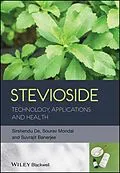
Stevioside is one of the naturally occurring sweeteners,
belonging to the diterpene glycoside family, which can be widely
applied in food, drinks, medicine and consumer chemicals. It is a
good dietary supplement, being non-calorific, thermally stable,
non-toxic, with a sugar-like taste profile, and suitable for
diabetics, phenylketonuria patients and the obese. It is also
non-fermentable, and exhibits anti-carcinogenic, antioxidant and
anti-hyperglycemic properties. Stevioside tastes about 300 times
sweeter than 0.4% sucrose solution. Thus, it offers a reasonably
rare combination of health benefits and taste benefits, making the
extraction of stevioside is an area of active research for the food
industry as well as academic food scientists.With the rapid
increase in the popularity of stevioside as a sugar substitute,
particularly with regard to its associated health benefits, there
is a need for more efficient and feasible extraction processes for
stevioside in the near future.
This book offers an in-depth look at perhaps the major
"sugar alternative of the future", up-to-date and in
line with the latest global legislation regarding its suitability
for consumption and its scope for application.
Autorentext
About the authors
Sirshendu De is a professor in the Department of Chemical Engineering, Indian Institute of Technology (IIT) Kharagpur, Kharagpur, India.
Sourav Mondal is a researcher in the Department of Chemical Engineering, Indian Institute of Technology (IIT) Kharagpur, Kharagpur, India.
Suvrajit Banerjee was Master of Technology in 2012 at the Indian Institute of Technology (IIT) Kharagpur, Kharagpur, India.
Klappentext
Stevioside is a naturally occurring sweetener that can be widely applied in food, drinks, medicine and consumer chemicals. It is a good dietary supplement, being non-calorific, thermally stable and non-toxic. It is also non-fermentable and exhibits anti-carcinogenic, antioxidant and anti-hyperglycemic properties. With its sugar-like taste profile, it is suitable for diabetics, phenylketonuria patients and the obese. As stevioside tastes about 300 times sweeter than 0.4% sucrose solution, it offers a rare combination of health and taste benefits. The extraction of stevioside is therefore an area of active research for the food industry as well as academic food scientists.
Stevioside is produced from the leaves of the Stevia plant. Current sweetener extraction techniques involve solvent extraction (methanol and ethanol), ion exchange, and other techniques. However, solvent extraction is a process that may not be suitable for ingredients which are designed for subsequent human consumption, whilst ion exchange is not economical. Membrane-based processes can offer an attractive alternative. Stevioside: Technology, Applications and Health will provide a detailed understanding of design and modeling characteristics at various levels of processing using membranes.
Although its accessibility varies from country to country, the number of countries in which stevioside is available as a sweetener has gradually been increasing. In 2011, stevioside was approved for use in the EU and is therefore on the cusp of being more widely-used than ever before. Stevioside: Technology, Applications and Health offers an in-depth look at perhaps the major 'sugar alternative of the future'; an overview that is up-to-date and in line with the latest global legislation regarding its suitability for consumption and its scope for application.
Also available
Membrane Processing: Dairy and Beverage Applications
Edited by A.Y. Tamime
ISBN 978-1-4443-3337-4
Sweeteners and Sugar Alternatives in Food Technology, Second Edition
Edited by K. O'Donnell and M.W. Kearsley
ISBN 978-0-4706-5968-7
Chemistry of Food Additives and Preservatives
Titus A.M. Msagati
ISBN 978-1-1182-7414-9
Zusammenfassung
Stevioside is one of the naturally occurring sweeteners, belonging to the diterpene glycoside family, which can be widely applied in food, drinks, medicine and consumer chemicals. It is a good dietary supplement, being non-calorific, thermally stable, non-toxic, with a sugar-like taste profile, and suitable for diabetics, phenylketonuria patients and the obese. It is also non-fermentable, and exhibits anti-carcinogenic, antioxidant and anti-hyperglycemic properties. Stevioside tastes about 300 times sweeter than 0.4% sucrose solution. Thus, it offers a reasonably rare combination of health benefits and taste benefits, making the extraction of stevioside is an area of active research for the food industry as well as academic food scientists.With the rapid increase in the popularity of stevioside as a sugar substitute, particularly with regard to its associated health benefits, there is a need for more efficient and feasible extraction processes for stevioside in the near future.
This book offers an in-depth look at perhaps the major sugar alternative of the future, up-to-date and in line with the latest global legislation regarding its suitability for consumption and its scope for application.
Inhalt
Authors' Biographies vii
Preface ix
Acknowledgements xi
List of figures xiii
List of tables xvii
1 Introduction to stevioside 1
1.1 History of Stevia 3
1.2 Composition of Stevia 6
1.3 Source of stevioside 10
1.4 Physicochemical and biological properties of steviol glycosides 13
1.5 Analysis of stevioside (steviol glycosides) and Stevia extract 18
2 Health benefits and pharmacological effects of steviol glycosides 27
2.1 Effect of stevioside in absorption, distribution, metabolism and excretion 27
2.2 Antihyperglycaemic effect 29
2.3 Antihypertensive effect 31
2.4 Anti-inflammatory effect 32
2.5 Anticarcinogenic antitumour effects 33
2.6 Antioxidant activity 34
2.7 Antimicrobial and antidiarrhoeal effects 34
2.8 Effect on renal function 35
3 Applications of stevioside 45
4 Conventional extraction processes of stevioside 51
4.1 Ion exchange 51
4.2 Solvent extraction 53
4.3 Extraction by chelating agents 54
4.4 Adsorption and chromatographic separation 56
4.5 Ultrasonic extraction 59
4.6 Microwave-assisted extraction 59
4.7 Supercritical fluid extraction 60
5 Brief introduction to pressure-driven membrane-based processes 65
5.1 Advantages of the membrane-based process 66
5.2 Classification of the processes 66
5.3 Characterisation of membranes 67
5.4 Membrane modules 70
5.5 Limitations 73
5.6 Quantification of concentration polarisation 74
5.7 Applications of membrane-based processes 79
6 State of the art of stevioside processing using membrane-based filtration 91
6.1 Clarification and purification 92
6.2 Concentration by nanofiltration 95
6.3 Limitations 97
7 Detailed membrane-based technologies for extraction of stevioside 99
7.1 Outline of processing 99
7.2 Optimisation of water extraction process 99
7.3 Optimisation of primary clarification (centrifuge or microfiltration) 109
7.4 Selection of membrane 122
7.5 Optimisation of operating conditions 124
7.6 Mechanism of flux decline 130
7.7 Ultrafiltration of primary clarified Stevia extract 141
7.8 Concentration by nanofiltration 155
8 Performance modelling of stevioside separation using membrane processing 161
8.1 Modelling of stirred ultrafiltration 162
8.2 Modelling of cross-flow ultrafiltration 174
…