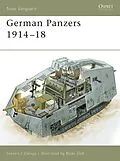
Panzer warfare is synonymous with the Wehrmacht of World War II.
Germany was very slow to develop armored vehicles compared to Britain and France. Efforts to catch-up proved difficult, and only a few dozen German A7V tanks were completed in time to take part in the final campaigns of 1918. As a result, the majority of German panzer units actually used captured British tanks, the Beutepanzer.
This book will trace the development of German panzers of the World War One, including the A7V and its intended but unfinished stablemates.
Autorentext
Steven J Zaloga has worked as an analyst in the aerospace industry for over two decades, covering missile systems and the international arms trade, and has served with the Institute for Defense Analyses, a federal think-tank. He has written extensively on armored vehicle development, including a book in the earlier Osprey Vanguard series, VND N.46, Renault FT Light Tank (London, Osprey, 1988).
Brian Delf is a freelance illustrator on a variety of subjects including natural history, architecture and technical cutaways. His illustrated books have been published in over 30 countries. Brian lives and works in Oxfordshire.
Zusammenfassung
Panzer warfare is synonymous with the Wehrmacht of World War II.Germany was very slow to develop armored vehicles compared to Britain and France. Efforts to catch-up proved difficult, and only a few dozen German A7V tanks were completed in time to take part in the final campaigns of 1918. As a result, the majority of German panzer units actually used captured British tanks, the Beutepanzer.This book will trace the development of German panzers of the World War One, including the A7V and its intended but unfinished stablemates.
Inhalt
Introduction * Early Roots * The Early Tank Program * The Cambrai Shock * A7V Variants *Panzers in Training * Into Combat * Rebuilding the Tank Units * German Armored Cars in Combat * Final Tank Battles * Plan 1919 * Further Reading * Color Plate Commentary * Index