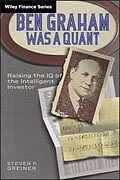
Innovative insights on creating models that will help you become
a disciplined intelligent investor
The pioneer of value investing, Benjamin Graham, believed in a
philosophy that continues to be followed by some of today's most
successful investors, such as Warren Buffett. Part of this
philosophy includes adhering to your stock selection process come
"hell or high water" which, in his view, was one of the most
important aspects of investing.
So, if a quant designs and implements mathematical models for
predicting stock or market movements, what better way to remain
objective, then to invest using algorithms or the quantitative
method? This is exactly what Ben Graham Was a Quant will
show you how to do. Opening with a brief history of quantitative
investing, this book quickly moves on to focus on the fundamental
and financial factors used in selecting "Graham" stocks,
demonstrate how to test these factors, and discuss how to combine
them into a quantitative model.
* Reveals how to create custom screens based on Ben Graham's
methods for security selection
* Addresses what it takes to find those factors most influential
in forecasting stock returns
* Explores how to design models based on other styles and
international strategies
If you want to become a better investor, you need solid insights
and the proper guidance. With Ben Graham Was a Quant, you'll
receive this and much more, as you learn how to create quantitative
models that follow in the footsteps of Graham's value
philosophy.
Autorentext
STEVEN P. GREINER, Ph.D., has served as the senior quantitative strategist and portfolio manager for Allegiant Asset Management (now wholly owned by PNC Capital Advisors) and was a member of its Investment Committee. Prior to this, he was a senior quantitative strategist for large capitalization investments at Harris Investment Management. He has more than twenty years of quantitative and modeling experience. Currently, Dr. Greiner is the head of Risk Research for FactSet Research Systems. He received a BS in mathematics and chemistry from the University of Buffalo, an MS and PhD in physical chemistry from the University of Rochester, and attained postdoctoral experience from the Free University Berlin, Department of Physics.
Klappentext
The pioneer of value investing, Benjamin Graham, believed in a philosophy that continues to be followed by some of today's most successful investors, such as Warren Buffett. Part of this philosophy includes adhering to your stock selection process come "hell or high water," which, in his view, was one of the most important aspects of investing.
So, if a quant designs and implements mathematical models for predicting stock or market movements, what better way to remain objective than to invest using algorithms in a quantitative method? This is exactly what Ben Graham Was a Quant will show you how to do.
Opening with a brief history of quantitative investing, this book quickly moves on to focus on the fundamental and financial factors used in selecting "Graham" stocks, demonstrate how to test these factors with current software, and discuss how to combine them into a quantitative model. Along the way, Ben Graham Was a Quant also takes the time to define the search for Alpha and explain what it is, highlight some of the inadequacies of modern portfolio theory, and introduce specific risk measures you should become familiar with.
One of the best aspects of quantitative investing is that it ultimately leads to disciplined, and intelligent, investing. Ben Graham Was a Quant will help you achieve this goal by codifying Graham's value philosophy and combining it with quantitative methods—all while using a minimum of mathematics. With this book as your guide, you'll discover a better way to invest, as you learn how to create quantitative models that follow in the footsteps of Graham's proven value approach.
Zusammenfassung
Innovative insights on creating models that will help you become a disciplined intelligent investor
The pioneer of value investing, Benjamin Graham, believed in a philosophy that continues to be followed by some of today's most successful investors, such as Warren Buffett. Part of this philosophy includes adhering to your stock selection process come "hell or high water" which, in his view, was one of the most important aspects of investing.
So, if a quant designs and implements mathematical models for predicting stock or market movements, what better way to remain objective, then to invest using algorithms or the quantitative method? This is exactly what Ben Graham Was a Quant will show you how to do. Opening with a brief history of quantitative investing, this book quickly moves on to focus on the fundamental and financial factors used in selecting "Graham" stocks, demonstrate how to test these factors, and discuss how to combine them into a quantitative model.
- Reveals how to create custom screens based on Ben Graham's methods for security selection
- Addresses what it takes to find those factors most influential in forecasting stock returns
- Explores how to design models based on other styles and international strategies
If you want to become a better investor, you need solid insights and the proper guidance. With Ben Graham Was a Quant, you'll receive this and much more, as you learn how to create quantitative models that follow in the footsteps of Graham's value philosophy.
Inhalt
Preface xi
Introduction: The Birth of the Quant 1
Characterizing the Quant 3
Active versus Passive Investing 6
Chapter 1 Desperately Seeking Alpha 11
The Beginnings of the Modern Alpha Era 16
Important History of Investment Management 18
Methods of Alpha Searching 20
Chapter 2 Risky Business 27
Experienced versus Exposed Risk 28
The Black Swan: A Minor ELE EventAre Quants to Blame? 34
Active versus Passive Risk 38
Other Risk Measures: VAR, C-VAR, and ETL 49
Summary 52
Chapter 3 Beta is Not Sharpe Enough 55
Back to Beta 64
Beta and Volatility 65
The Way to a Better Beta: Introducing the g-Factor 67
Tracking Error: The Deviant Differential Measurer 75
Summary 77
Chapter 4 Mr. Graham, I Give You Intelligence 79
Fama-French Equation 81
The Graham Formula 89
Factors for Use in Quant Models 90
Momentum: Increasing Investor Interest 96
Volatility as a Factor in Alpha Models 113
Chapter 5 Modeling Pitfalls and Perils 123
Data Availability, Look-Ahead, and Survivorship Biases 124
Building Models You Can Trust 127
Scenario, Out-of-Sample, and Shock Testing 131
Data Snooping and Mining 139
Statistical Significance and Other Fascinations 140
Choosing an Investment Philosophy 148
Growth, Value, Quality 149
Investment Consultant as Dutch Uncle 152
Where Are the Relative Growth Managers? 154
Chapter 6 Testing the Graham Crackers . . . er, Factors 159
The First Tests: Sorting 160
Time-Series Plots 173
The Next Tests: Scenario Analysis 182
Chapter 7 Building Models from Factors 193
Surviving Factors 194
Weighting the Factors 197
The Art versus Science of Modeling 200
Time Series of Returns 210
Other Conditional Information 215
The Final Model 217
Other Methods of Measuring Performance: Attribution Analysis via Brinson and Risk Decomposition 220
Regression of the Graham Factors with Forward Returns 228
Chapter 8 Building Portfolios from Models…