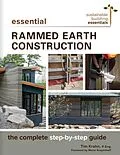
"All of the essential knowledge for completing a successful rammed earth project. Written by a geo-technical engineer with experience ramming earth." -Kelly Hart, author, Essential Earthbag Construction Everything you need to know to build with rammed earth in warm and cold climates. Rammed earth-sand, gravel, and clay or lime/cement binder packed into forms-is a low-energy, high-performance building method, yielding beautiful, sustainable results. It's thermally stable and can be insulated, can actively modulate humidity, provides a healthy indoor environment, and allows site materials to be used for major structural and building envelope elements. Essential Rammed Earth Construction covers design, building science, tools, and step-by-step building methods for any climate, with a special emphasis on building in cold climates of the northern US, Canada, and northern Europe. Coverage includes:
- Overview of earthen building
- Appropriate use of rammed earth walls
- Stabilized versus raw rammed earth
- Design considerations, including structural, insulation, and building envelope details
- Special considerations for cold and freeze-thaw climates
- Construction drawings, with step-by-step building instructions
- Tools and labor covering industrial methods, low-tech techniques, formwork options, mix design, budgets, and schedules
- Codes, inspections, and permits.
Autorentext
Tim J. Krahn, P. Eng. is a registered professional engineer and partner in Building Alternatives Inc., consulting engineers specializing in non-conventional structural and building envelope design. He holds a masters degree in geotechnical engineering, a bachelors degree in civil engineering, is a founding member of the Natural Building Engineering Group, and is the chair of the Ontario Natural Building Coalition. He currently resides in Ontario, Canada.
Klappentext
Everything you need to know to build with rammed earth in warm and cold climates.
Rammed earth - sand, gravel, and clay or lime/cement binder packed into forms - is a low-energy, high-performance building method, yielding beautiful, sustainable results. It's thermally stable and can be insulated, can actively modulate humidity, provides a healthy indoor environment, and allows site materials to be used for major structural and building envelope elements.
Essential Rammed Earth Construction covers design, building science, tools, and step-by-step building methods for any climate, with a special emphasis on building in cold climates of the northern US, Canada, and northern Europe. Coverage includes:
- Overview of earthen building
- Appropriate use of rammed earth walls
- Stabilized versus raw rammed earth
- Design considerations, including structural, insulation, and building envelope details
- Special considerations for cold and freeze-thaw climates
- Construction drawings, with step-by-step building instructions
- Tools and labor covering industrial methods, low-tech techniques, formwork options, mix design, budgets, and schedules
- Codes, inspections, and permits.
This guide is an essential resource for experienced builders, DIY home owners, designers, engineers, and architects interested in learning about rammed earth construction.
Inhalt
Acknowledgments
Foreword By Meror Krayenhoff
Chapter 1: Introduction
Chapter 2: Rationale and Appropriate Use
Chapter 3: Building Science Notes
Chapter 4: Materials
Chapter 5: Wall System Examples and Structural Design Considerations
Chapter 6: Tools and Mixing
Chapter 7: Construction Methods
Chapter 8: Cost Estimates Based on a Cement-Stabilized Rammed Earth Project
Chapter 9: Wall Surfaces, Openings, and Embedments
Chapter 10: Building Code Developments
Appendix A: Sample Engineering Specification
Appendix B: Alternative Solutions Proposal
Definitions
Resources and Material Suppliers
Bibliography
Index
About the Author
A Note About the Publisher