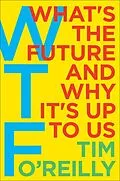
Can we master the technologies we create before they master us? A "punchy and provocative" assessment by one of Silicon Valley's sharpest observers ( Financial Times).
WTF? can be an expression of amazement or of dismay-and today's technology elicits both reactions. In thisbook, Tim O'Reilly, dubbed "the Oracle of Silicon Valley" by Inc. magazine, explores the upsides-and potential downsides-of today's WTF? technologies.
What is the future when an increasing number of jobs can be performed by intelligent machines instead of people, or done onlyby people in partnership with those machines? What happens to our consumer-based societies-to workers and the companies that depend on their purchasing power? Is income inequality and unemployment an inevitable consequence of technological advancement, or are there paths to a better future? What will happen to business when technology-enabled networks and marketplaces are better at deploying talent than traditional companies?How should companies organize themselves to take advantage of these new tools?What's the future of education when on-demand learning outperforms traditional institutions? How can individuals adapt and retrain? Will the fundamental social safety nets of the developed world survive the transition, and if not, what will replace them?
O'Reilly is "the man who can really can make a whole industry happen," according toformer Google CEO Eric Schmidt, and for decades he's identified and helped shape our response to emerging technologies with world-shaking potential-from the World Wide Web to Big Data and AI. Here, heshares the techniques he's used at O'Reilly Mediato anticipate innovation waves and provides a framework for thinking about how current innovations are changing the nature of business, education, government, financial markets, and the economy as a whole. He helps us understand how the parts of digital businesses work together to create marketplace advantage and customer value, and why ultimately, they cannot succeed unless their ecosystem succeeds along with them.
O'Reilly exhorts businesses to DO MORE with technology rather than just using it to cut costs and enrich their shareholders. Robots are going to take our jobs, they say. O'Reilly replies, "Only if that's what we ask them to do! Technology is the solution to human problems, and we won't run out of work till we run out of problems."Whether technology brings the WTF? of wonder or the WTF? of dismay isn't inevitable. It's up to us.
"A compelling narrative of how technology interweaves with the real world. If it can cajole even a few tech titans to dwell on the social and political impact of what they do then it will have served a useful purpose." - Financial Times
"WTF? is a book about technology as it was, as it is, and as it could be. It is told from the perspective of someone who has been personally present at the most important moments in the fast-paced history of tech, and who played a significant role in those moments... Please do read this book." -Cory Doctorow, Boing Boing
Autorentext
Tim O'Reilly is the founder and CEO of O'Reilly Media, the company that has been providing the picks and shovels of learning to the Silicon Valley gold rush for the past thirty-five years. The company delivers online learning, publishes books, runs conferences, and has repeatedly shaped the discussion for each successive wave of innovation. Tim is also a partner at O'Reilly AlphaTech Ventures, an early stage venture firm, and is on the boards of Code for America, Maker Media, PeerJ, Civis Analytics, and PopVox.
Klappentext
WTF? can be an expression of amazement or an expression of dismay. In today's economy, we have far too much dismay along with our amazement, and technology bears some of the blame. In this combination of memoir, business strategy guide, and call to action, Tim O'Reilly, Silicon Valley's leading intellectual and the founder of O'Reilly Media, explores the upside and the potential downsides of today's WTF? technologies.
What is the future when an increasing number of jobs can be performed by intelligent machines instead of people, or done only by people in partnership with those machines? What happens to our consumer based societies—to workers and to the companies that depend on their purchasing power? Is income inequality and unemployment an inevitable consequence of technological advancement, or are there paths to a better future? What will happen to business when technology-enabled networks and marketplaces are better at deploying talent than traditional companies? How should companies organize themselves to take advantage of these new tools? What's the future of education when on-demand learning outperforms traditional institutions? How can individuals continue to adapt and retrain? Will the fundamental social safety nets of the developed world survive the transition, and if not, what will replace them?
O'Reilly is "the man who can really can make a whole industry happen," according to Eric Schmidt, Executive Chairman of Alphabet (Google.) His genius over the past four decades has been to identify and to help shape our response to emerging technologies with world shaking potential—the World Wide Web, Open Source Software, Web 2.0, Open Government data, the Maker Movement, Big Data, and now AI. O'Reilly shares the techniques he's used at O'Reilly Media to make sense of and predict past innovation waves and applies those same techniques to provide a framework for thinking about how today's world-spanning platforms and networks, on-demand services, and artificial intelligence are changing the nature of business, education, government, financial markets, and the economy as a whole. He provides tools for understanding how all the parts of modern digital businesses work together to create marketplace advantage and customer value, and why ultimately, they cannot succeed unless their ecosystem succeeds along with them.
The core of the book's call to action is an exhortation to businesses to DO MORE with technology rather than just using it to cut costs and enrich their shareholders. Robots are going to take our jobs, they say. O'Reilly replies, "Only if that's what we ask them to do! Technology is the solution to human problems, and we won't run out of work till we run out of problems." Entrepreneurs need to set their sights on how they can use big data, sensors, and AI to create amazing human experiences and the economy of the future, making us all richer in the same way the tools of the first industrial revolution did. Yes, technology can eliminate labor and make things cheaper, but at its best, we use it to do things that were previously unimaginable! What is our poverty of imagination? What are the entrepreneurial leaps that will allow us to use the technology of today to build a better future, not just a more efficient one? Whether technology brings the WTF? of wonder or the WTF? of dismay isn't inevitable. It's up to us!
Zusammenfassung
WTF? can be an expression of amazement or an expression of dismay. In todays economy, we have far too much dismay along with our amazement, and technology bears some of the blame.In thiscombination of memoir, business strategy guide, and call to action, Tim O'Reilly, Silicon Valleys leading intellectual and the founder of OReilly Media, explores the upside and the potential downsides of today's WTF? technologies.What is the future when an increasing number of jobs can be performed by intelligent machines instead of people, or done onlyby people in partnership with those machines? What happens to our consumer based societiesto workers and to the companies that depend on their purchasing power? Is income inequality and unemployment an inevitable consequence of technological advancement, or are there paths to a better …