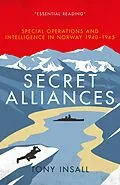
In this extraordinary book, historian Tony Insall reveals how some of the most striking achievements of the Norwegian resistance were the detailed reports produced by intelligence agents living in the dangerous conditions of the country's desolate wilderness.
A definitive appraisal of Anglo-Norwegian WWII cooperation, Secret Alliances provides remarkable insights into the uniquely close political relationship that afforded powerful assistance for a successful resistance movement. Using previously unpublished archival material from London, Oslo and Moscow, Insall explores how SIS and SOE developed productive links with their Norwegian counterparts - and examines the crucial intelligence from the Security Service and Bletchley Park codebreakers who supported their sabotage operations.
Offering dramatic details on operations such as gunnerside - which targeted the heavy water plant in Vemork in order to foil the Nazis' plans to build an atomic bomb - and the sinking of the Tirpitz in November 1944, Secret Alliances is an authoritative new perspective on some of the most remarkable exploits of the Second World War.
Autorentext
Dr Tony Insall worked for more than thirty years in the Foreign and Commonwealth Office and served in Nigeria, Hong Kong, China and Malaysia, before spending five years in Norway. He was also an associate editor of FCO Historians and has published several books and articles on Norwegian history. He is a senior visiting fellow in the Department of War Studies at King's College London and a fellow of the Royal Historical Society. He lives near Guildford in Surrey.
Klappentext
Europe, 1940. Nazi forces sweep across the continent, with A British invasion likely only weeks away. Never before has a resistance movement been so crucial to the war effort.
In this definitive appraisal of Anglo-Norwegian cooperation in the Second World War, Tony Insall reveals how some of the most striking successes of the Norwegian resistance were the reports produced by the heroic SIS agents living in the country's desolate wilderness. Their coast-watching intelligence highlighted the movements of the German fleet and led to counter-strikes which sank many enemy ships - most notably the Tirpitz in November 1944.
Using previously unpublished archival material from London, Oslo and Moscow, Insall explores how SIS and SOE worked effectively with their Norwegian counterparts to produce some of the most remarkable achievements of the Second World War.