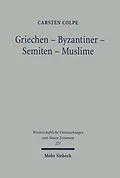
Carsten Colpe examines an epoch of de-Hellenization. This epoch can be most clearly recognized by the decline of the use of the Greek language. However in institutions, the arts, religion, languages and literature as well there was a powerful Greek impetus, which then declined gradually.
Carsten Colpe examines an epoch of de-Hellenization, one which is important from the standpoint of cultural history but which has often been misjudged. This epoch can be most clearly recognized by the decline of the use of the Greek language. However in institutions, the arts, religion, languages and literature as well there was a powerful Greek impetus, which then declined gradually. The history of de-Hellenization is put into the terms of a phenomenology which is divided into 21 sections. These range from the golden age of Hellenism in the 3rd/2nd century BC and the substantial Byzantine and Asiatic documents which support this to the rise of Hellenism in northern India in the 17th century.
Autorentext
Geboren 1929; Studium der Evangelischen Theologie, der Orientalischen Philologie und der Philosophie; Promotion 1955 (Dr. phil.) und 1960 (Dr. theol.); 1960 Habilitation; Professor in Göttingen; Visiting Professor in Yale, Chicago und an der British Academy in London; 1969-74 Professor für Iranische Philologie, 1975-97 Professor für Allgemeine Religionsgeschichte und Historische Theologie an der FU Berlin; 1997 emeritiert.
Carsten Colpe examines an epoch of de-Hellenization, one which is important from the standpoint of cultural history but which has often been misjudged. This epoch can be most clearly recognized by the decline of the use of the Greek language. However in institutions, the arts, religion, languages and literature as well there was a powerful Greek impetus, which then declined gradually. The history of de-Hellenization is put into the terms of a phenomenology which is divided into 21 sections. These range from the golden age of Hellenism in the 3rd/2nd century BC and the substantial Byzantine and Asiatic documents which support this to the rise of Hellenism in northern India in the 17th century.
Autorentext
Geboren 1929; Studium der Evangelischen Theologie, der Orientalischen Philologie und der Philosophie; Promotion 1955 (Dr. phil.) und 1960 (Dr. theol.); 1960 Habilitation; Professor in Göttingen; Visiting Professor in Yale, Chicago und an der British Academy in London; 1969-74 Professor für Iranische Philologie, 1975-97 Professor für Allgemeine Religionsgeschichte und Historische Theologie an der FU Berlin; 1997 emeritiert.
Titel
Griechen - Byzantiner - Semiten - Muslime
Untertitel
Hellenistische Religionen und die west-östliche Enthellenisierung. Phänomenologie und philologische Hauptkapitel
Autor
EAN
9783161573576
Format
E-Book (pdf)
Hersteller
Genre
Digitaler Kopierschutz
Adobe-DRM
Dateigrösse
41.07 MB
Anzahl Seiten
527
Lesemotiv
Unerwartete Verzögerung
Ups, ein Fehler ist aufgetreten. Bitte versuchen Sie es später noch einmal.